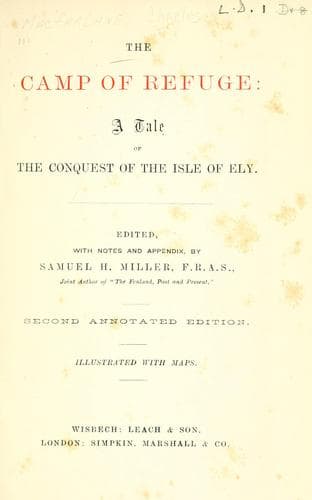
The Camp of Refuge: A Tale of the Conquest of the Isle of ElyMacFarlane, Charles
History
The Camp of Refuge: A Tale of the Conquest of the Isle of Ely
MacFarlane, Charles
Great Britain -- History -- Medieval period, 1066-1485 -- Fiction
this public court of justice, wherein such as had stolen their
neighbours’ goods were condemned to make bot, the bountiful Lord Abbat
bade the good people of Dereham to a feast. And while the good folk of
Dereham were eating and drinking, and making merry, and were thinking
of nought but the good meat and abundant drink before them, the sturdy
loaf-eaters from Ely, unwatched and unnoticed, and working in great
stillness, were making those preparations for the translation which
they had been ordered to make. And, at the time pre-concerted and
fixed, my Lord Abbat and his active and prudent monks took occasion to
withdraw from the carousing company in the hall, and immediately
repaired to the church under colour of performing their regular
devotions. But they left the service of Nones unsaid for that day,
taking no heed of the canonical hours, but getting all things ready for
the happy and peaceful translation. After a time the abbat and his
prudent monks returned to the company and caused more drink to be
brought into the hall, still farther to celebrate the happy day of his
lordship’s taking possession. The whole day having been spent in
feasting and drinking, and dark night coming on apace, the company
retired by degrees, every man to his own house or hut, his home or
present resting place: and thereupon the monks went again to the
church, opened the tomb (of which the fastenings had been forced),
opened the coffin, and devoutly inspected the body of Saint Withburga,
and having inspected and revered it they closed up the coffin again,
and got everything in readiness for carrying it off. About the middle
of the night, or between the third and fourth watch when the matutina
or lauds are begun to be sung, the coffin in which the body of the
saint was inclosed, was put upon the shoulders of the active and
prudent monks, who forthwith conveyed it with great haste and without
any noise-making to a wheeled car which had been provided for that
purpose. The coffin was put into the car, the servants of the abbat
were placed as guards round about the car to defend it, the Lord Abbat
and the monks followed the car in processional order, other well-armed
loaf-eaters followed the abbat and the monks; and in this order they
set forward for Brandon. The journey was long and anxious, but when
they came to the village of Brandon and to the bank of the river which
leads towards the house of Ely, they found ready and waiting for them
the boats which the abbat had commanded, and immediately embarking with
their precious treasure they hoisted sail and made ply their oars at
the same time. In the meanwhile the men of Dereham, having recovered
from the deep sleep and the confusion of ideas which are brought on by
much strong drink, had discovered that the monks of Ely had stolen the
body of Saint Withburga. Hullulu! never was such noise heard in so
small a place before. Every man, woman, and child in Dereham was
Public-domain text, read in full here on John Shaqi.
Reviews
Reviews
No reviews yet
Be the first to share your thoughts on this work.
Elsewhere in the archive
Join the Discussion
Join the discussion
Sign in to leave a comment or review.
Sign InorCreate an account