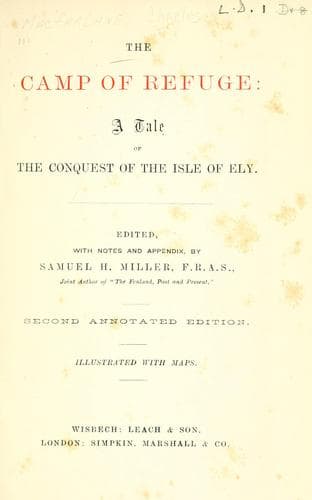
The Camp of Refuge: A Tale of the Conquest of the Isle of ElyMacFarlane, Charles
History
The Camp of Refuge: A Tale of the Conquest of the Isle of Ely
MacFarlane, Charles
Great Britain -- History -- Medieval period, 1066-1485 -- Fiction
roused, and ran shrieking to the empty tomb in the church, and at the
sound of the horn, all the people from all the hamlets and homesteads
near unto the pleasant hill of Dereham came trooping in with bills and
staves, not knowing what had happened, but fancying that the fiery Dane
was come again. But when they saw or were told about the empty tomb,
the people all shouted “Who hath done this deed? Who hath stolen the
body of our saint?” Now no one could gainsay that the Abbat of Ely with
his monks had done it. A serf who had gone early a-field to cut grass
while the dew was on it, had met the car and the procession on the road
between Dereham and Brandon; and what was of more significance, the
presbyter or mass-priest of the church of Dereham, coming to the
communion-table found upon it a piece of parchment whereon was written
these words: “I, Abbat of Ely and Lord of Dereham, by and with the
consent and approval of Edgar the King, have translated the body of
Saint Withburga, to be hereafter kept in Ely Abbey with increased pomp,
worship, and reverence; and this, oh presbyter of Dereham, is my
receipt for the blessed body aforesaid.” Then, I wis, were heard words
of much irreverence from the ignorant and rustical people of the place!
Some of them stopped not in calling the right excellent abbat a thief,
a midnight robber, a perturbator of the peace of saints, a violator of
the tombs of the saints! Nor did they spare King Edgar more than the
abbat, saying that although he might by his kingly power and without
wrong grant to the house at Ely their lands and services, and even
their church, he had no right to give away the body of their saint, and
order it to be removed out of their church, wherein it had reposed for
thrice one hundred years; and they all presently agreed to pursue the
abbat and the monks, and endeavour to recover the prey. And so, arming
themselves with whatsoever weapons they could most readily meet with,
they all poured out of Dereham, and took the shortest way to
Brandon.[224] They were brisk men these folk of the uplands, well
exercised in the game of bowls, and in pitching the bar, and in running
and leaping, and in wrestling on the church-green; they were
light-footed men these men of Dereham; but although they ran their best
it was all too late when they got to Brandon, for the monks had got a
long way down the river with the saint’s body. Nevertheless the Dereham
folk continued the chase; they divided themselves into two bands or
parties, and while one party ran down one bank of the river, the other
ran down on the opposite side. They even came abreast of the Lord
Abbat’s boats, and got near enough to see the pall which covered the
coffin that contained the body of their saint; but the river being here
broad and deep, and they being unprovided with boats (the prudent abbat
had taken care for that), they could not get at the coffin or at the
monks; and so, after spending some time on the banks shaking their
Public-domain text, read in full here on John Shaqi.
Reviews
Reviews
No reviews yet
Be the first to share your thoughts on this work.
Elsewhere in the archive
Join the Discussion
Join the discussion
Sign in to leave a comment or review.
Sign InorCreate an account