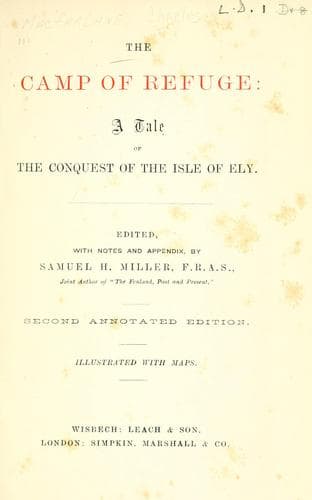
The Camp of Refuge: A Tale of the Conquest of the Isle of ElyMacFarlane, Charles
History
The Camp of Refuge: A Tale of the Conquest of the Isle of Ely
MacFarlane, Charles
Great Britain -- History -- Medieval period, 1066-1485 -- Fiction
bill-hooks and staves, and uttering threats and reproaches till they
were tired, they gave up the pursuit as hopeless, and began to return
home with sad and very angry hearts. The Lord Abbat and the monks of
Ely continued their voyage without molestation.[225] They landed safely
on the same day, about a mile from Ely Abbey, at the place called
Tidbrithseie, but which men do now call Turbutsey.[226] Here they were
received with great joy and triumph by all sorts of people, who came
down to the waterside, with the monks and mass-priests, to meet them,
for all the in-dwellers of Ely town, and all the people that dwelt near
it, were as glad to get the body of the saint as the people of Dereham
were grieved to lose it. And at eventide, or about compline or second
vespers, on this self-same day, the body and coffin of the saint, being
put upon another car, was conveyed by land from Turbutsey to Ely, and
into the abbey, with solemn procession and the singing of praises to
God, and was then, with all due reverence and a _Te Deum Laudamus_ in
the choir, deposited in the abbey-church next to Saint Etheldreda, and
near unto Saint Sexburga and Saint Ermenilda. Now this happy
translation of Saint Withburga’s body took place on the eighth of the
month of July, in the year of our Lord nine hundred and seventy-four.
And is not the day of this translation ever observed as a high festival
by the monks of Ely? Much did the Lord Abbat congratulate himself on
his success; and well he might, for translations of the like kind, as
well before his time and since, have often been attended with fighting
and bloodshed, nay, with great battles between party and party, and the
death of many baptized men! But through the good policy and great
wisdom of this our Lord Abbat there was not a man that had either given
or received so much as a blow from a staff or cudgel. Head-aches there
had been at Dereham on first waking in the morning, but these had
proceeded only from the over-free use of the abbat’s strong drinks, and
were cured by the fresh morning air and the good exercise the men got
in running after their saint. _Decus et decor, divitiæ et miracula
omnia_—credit, grace, and ornament, riches and many miracles, did the
saint bring to the house of Ely! And mark the goodness and bounty of
the saint in making heavenly bot to the good folk of Dereham! There, in
the churchyard, and out of the grave wherein Withburga had been first
buried, sprang up a curing miraculous well to cure disorders of the
spirit as well as of the flesh. And have its waters ever ceased to
flow, and is it not called Saint Withburga’s well?[227] albeit the
vulgar do name it, now-a-days, the well of Saint Winifred.
Public-domain text, read in full here on John Shaqi.
Reviews
Reviews
No reviews yet
Be the first to share your thoughts on this work.
Elsewhere in the archive
Join the Discussion
Join the discussion
Sign in to leave a comment or review.
Sign InorCreate an account