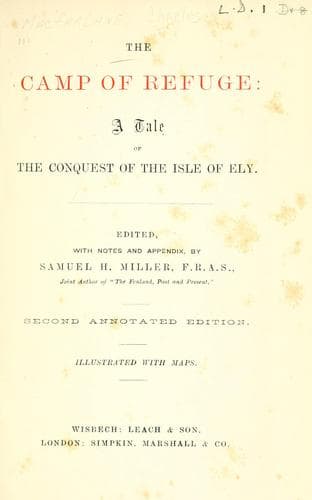
The Camp of Refuge: A Tale of the Conquest of the Isle of ElyMacFarlane, Charles
History
The Camp of Refuge: A Tale of the Conquest of the Isle of Ely
MacFarlane, Charles
Great Britain -- History -- Medieval period, 1066-1485 -- Fiction
HEREWARD STILL FIGHTS.
At the return of spring, Duke William being at Warwick Castle,[254] on
the pleasant river Avon, gave forth his mandate for the collecting of a
great army to proceed against the Lord of Brunn. Much had it vexed and
grieved his proud soul that Hereward should have escaped from the Camp
of Refuge in the Isle of Ely, and have made his name terrible in other
parts: for, during the winter, Peterborough and Stamford—aye, Grantham
and Newark—had heard the war-cry of the Lord of Brunn, and the Normans
there had been plundered by his band; and further still, where
Nottingham looks down upon Trent, Hereward had carried his successful
foray. “By the splendour,” quoth Duke William, as he thought upon those
things, “I would give back all the Saxon lives that were taken near Ely
for the life of this one man, who hath more power of mischief in him
than all the Saxons put together. Or I would give to him the broadest
earldom in all England if he would but submit and be my liege-man! I
need such a soldier, for the men that followed me from Normandie are
become all rich in this fat land, and risk not themselves in battle as
they used to do when their fortunes were to make by sword and lance.
This shall be thought of again, albeit my half-brother Odo and all my
Normans have vowed the death of that terrible Lord of Brunn, and think
that every hide of land left to a Saxon is so much robbed from them.”
During the spring months another mighty host was collected from out of
the several shires of Huntingdon, Cam-Bridge, Leicester, Nottingham,
Derby, Warwick, and others; and viscomtes and comtes, and knights of
great fame and long experience in war, were placed in command, and were
ordered to encompass the Lord of Brunn, and make an end of him or of
his resistance. No stores were spared; nothing was spared that was
thought likely to forward the one great object. Scarcely had William
made a greater array of strength when he first landed at Pevensey, to
march against King Harold at Hastings.
Public-domain text, read in full here on John Shaqi.
Reviews
Reviews
No reviews yet
Be the first to share your thoughts on this work.
Elsewhere in the archive
Join the Discussion
Join the discussion
Sign in to leave a comment or review.
Sign InorCreate an account