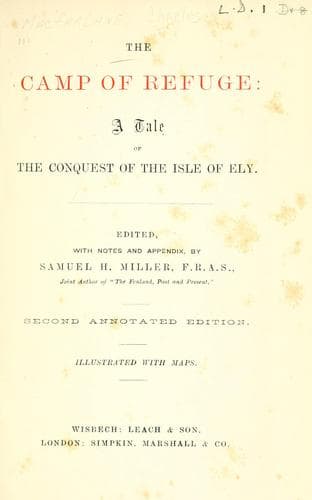
The Camp of Refuge: A Tale of the Conquest of the Isle of ElyMacFarlane, Charles
History
The Camp of Refuge: A Tale of the Conquest of the Isle of Ely
MacFarlane, Charles
Great Britain -- History -- Medieval period, 1066-1485 -- Fiction
But Hereward, that cunning captain and excellent soldier, _inclytus
miles_, was not idle during this season: he went hither and thither
throughout the country on the Wash and the whole fen country, calling
upon the fenners to be steady and true to him and their native land;
and to get their bows and arrows ready, and to sharpen such swords and
axes, or bill-hooks and spear-heads, as they might have; and to be ever
in a state of readiness to fight, if fighting could stead them, or to
retreat with their cattle into the inaccessible places and the
labyrinths among the waters and the meres. And the wandering menestrels
and gleemen, who had been driven hitherward from all other parts of
England, with Elfric, who was as good a gleemen as any of the number,
went from one township in the fens to another, singing the Saxon songs
which did honour to the Lord of Brunn, and told how often he had
prevailed in fight over the Norman invaders. And at the sound of these
songs the fenners gave up their peaceful occupations and prepared for
war; while many hundreds went at once to join the standard of the Lord
of Brunn. The men of Hoiland mounted themselves on their tall stilts,
and came wading across marsh and mere unto the manor-house of Spalding;
others came thither in their light skerries; others came on foot, with
their fen-poles in their hands, leaping such waters and drains as could
be leaped, and swimming across the rest like the water-fowls of the
fens. Loud blew the Saxon horn everywhere: the monks of Ely could hear
it in their cells by night, and their guests the Norman warriors, who
ventured not to come forth beyond Hadenham or Turbutsey, could hear it
in the hall or refectory by day. The country seemed all alive and
stirring, and full of strange sights: but the strangest sight of all
was that of the men from the shores of the Wash marching in troops on
their high stilts, carrying their bows and quivers and swords and pikes
at their backs, and looking, at a distance, with their long wooden
shanks and their bodies propped in the air, like troops of giant cranes
or herons. And ever as they went, and whether they went upon stilts or
upon their own feet, or in flitting skerries, or in heavier and slower
boats, these brave fenners sung in chorus the good songs which they had
learned from the gleemen. In this wise the Lord of Brunn had a great
force collected and in arms by the time of summer, when the waters had
abated and the green fields were showing themselves, and the Normans
were beginning to march, in the fantastic hope of encircling Hereward
as hunters gird in a beast of prey. There were no traitors here, as at
Ely, to show the short and safe ways across the fens; and Ivo
Taille-Bois, the only Norman chief that could be said to know a little
of the wild and difficult country, was a close prisoner in the house at
Spalding, where he tried to beguile the tedium of his captivity by
playing almost constantly at dice with the two Norman knights who had
Public-domain text, read in full here on John Shaqi.
Reviews
Reviews
No reviews yet
Be the first to share your thoughts on this work.
Elsewhere in the archive
Join the Discussion
Join the discussion
Sign in to leave a comment or review.
Sign InorCreate an account