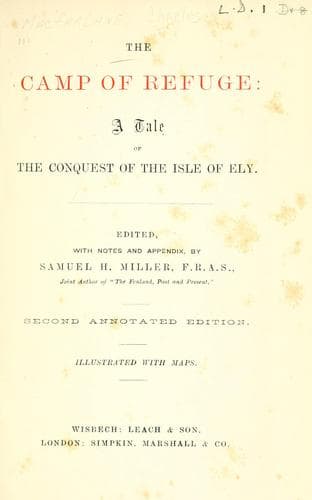
The Camp of Refuge: A Tale of the Conquest of the Isle of ElyMacFarlane, Charles
History
The Camp of Refuge: A Tale of the Conquest of the Isle of Ely
MacFarlane, Charles
Great Britain -- History -- Medieval period, 1066-1485 -- Fiction
He had sworn upon the relics of saints before now, and had broken his
oath; but this time King William was true to the vow he made, for great
and manifold were the advantages he reaped from the submission of the
Lord of Brunn. It needs not to say that the great Saxon warrior who had
ever been true to his saints and a scrupulous observer of his word, was
more than faithful to every part of his engagement. After he had been
to London city to pay homage to the king which it was the will of
Heaven to place over the country, he returned to his good house at
Brunn, and hung his sword and battle-axe upon the wall, never to take
them down again unless England should be invaded by the Scots or Danes.
King William, who went over into France to force his undutiful son
Robert to forego his plots and rebellions, and to take vengeance on the
French king (in both of which things he in the end succeeded), would
with a glad heart have carried Hereward, the cunning captain, the great
soldier, with him; and to tempt him into that service he made offer of
lofty titles and commands, and of many hides of land in the upland
country; but Hereward loved not to fight except for his own country and
countrymen, and against those who had wronged him and oppressed them;
and instead of clutching greedily at the king’s offers, as many English
lords had done, he preferred keeping his own in his own native parts,
and ever remained plain Lord of Brunn.
Ivo Taille-Bois returned to the manor-house at Spalding with his wife
and children; and albeit his brow was sometimes darkened by the
recollections of the wedding at Ey, and the defeat and surrender in the
marsh, and the hard life he had led as a prisoner in the fens, he lived
on the whole, in very good fellowship with his neighbour and cousin of
Brunn. Ivo never more harrowed the good Saxon monks of Spalding, who
were left for a long time to their own peaceful and happy government.
As for the traitorous monks of Crowland Abbey, who had brought back the
Normans, they fared after the same manner as the false monks at Ely and
the ungrateful monks at Peterborough; they were condemned by the
Saxons, harassed and plundered by the Normans they had served, and
fustigated by a sharp iracund abbat from France; and thus they did
penance for many years, and until most of them were dead, when their
cells were occupied by truer men, and the abbey of Crowland began again
to be the revered place it had been in former times.
Public-domain text, read in full here on John Shaqi.
Reviews
Reviews
No reviews yet
Be the first to share your thoughts on this work.
Elsewhere in the archive
Join the Discussion
Join the discussion
Sign in to leave a comment or review.
Sign InorCreate an account