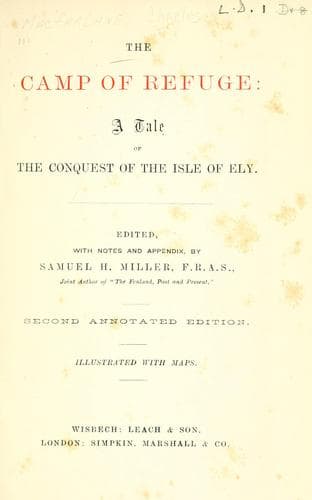
The Camp of Refuge: A Tale of the Conquest of the Isle of ElyMacFarlane, Charles
History
The Camp of Refuge: A Tale of the Conquest of the Isle of Ely
MacFarlane, Charles
Great Britain -- History -- Medieval period, 1066-1485 -- Fiction
As Lord Hereward had ever been averse to cruelty, and constant in his
endeavours to prevent his people being cruel to the prisoners they took
in battle, the Normans had no scores of vengeance against him; and when
they found that they were not to be gratified by dividing his broad
lands among them, as they had long expected to do, they lived in a
neighbourly manner with him, and even sought his friendship. Not one of
them but allowed that he had been a great warrior; and when the monks
of their nation, who had seen much of the war in England with their own
eyes, began to chronicle the war and to relate the high emprises of
William the Conqueror, maugre their Norman prejudices they paid a
tribute of praise and admiration to the military skill, and the
indomitable courage, and perseverance of Hereward, the son of Leofric,
Lord of Brunn.
There were troubles in the land after the year of grace one thousand
and seventy-six, but they came not near to Brunn. Twenty-four years
after the submission of Hereward, when the Conqueror was in his grave,
and his son Rufus had been slain by the arrow of a Norman knight, his
other son, Henry the Clerk, ascended the throne, and in so doing he
passed the good Charter called the Charter of Liberties, whereby he
restored the laws of King Edward the Confessor, and engaged to redress
all the grievances of the two preceding reigns. And shortly after his
accession to the throne, King Henry still further conciliated his
Anglo-Saxon subjects by espousing a Saxon wife, the fair Maud, daughter
of Malcolm, King of Scots, and of Margaret the good queen, the relation
of King Edward the Confessor, and of the right kingly kin of England.
Maud had been sent from Scotland at a very early age and committed to
the care of her English aunt Christina, the pious Abbess of Wilton.
Many great Norman lords, as Alain the Lord of Richmond, and William de
Garenne, Earl of Surrey, had asked her in marriage, but she had refused
them all; and even when Henry Beauclerc, a crowned and anointed king,
made suit for her hand, and offered to place her by his side on the
throne which her ancestors had sat upon for ages, she testified a
preference for the quiet religious life she was leading; and it
required the representations and entreaties of many noble Saxon friends
to make her forego her purpose of entering into religion. “Oh most
noble and fair among women,” said these Saxons, “if thou wilt, thou
canst restore the ancient honour of England, and be a pledge of
reconciliation and friendship; but if thou art obstinate in thy
refusal, the enmity between the two races will endure, and the shedding
of human blood know no end!” To these representations she yielded; and
those Saxons who had advised her lived to see much good to England
proceed from the marriage, which was a great step towards that
intermixture of the Saxon and Norman races which had been begun many
years before, and which we have since seen proceed so rapidly. The
Public-domain text, read in full here on John Shaqi.
Reviews
Reviews
No reviews yet
Be the first to share your thoughts on this work.
Elsewhere in the archive
Join the Discussion
Join the discussion
Sign in to leave a comment or review.
Sign InorCreate an account