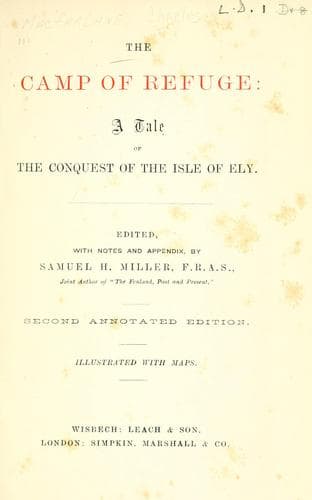
The Camp of Refuge: A Tale of the Conquest of the Isle of ElyMacFarlane, Charles
History
The Camp of Refuge: A Tale of the Conquest of the Isle of Ely
MacFarlane, Charles
Great Britain -- History -- Medieval period, 1066-1485 -- Fiction
In no time had there been at the house of Ely so great and glorious a
festival of the Nativity as that holden in the year of Grace one
thousand and seventy, the day after the return of the Saxon commander
Hereward, Lord of Brunn. Learned brothers of the house have written
upon it, and even to this day the monks of Ely talk about it. On the
day next after the feast, several hours before sunrise, the mariners in
the unloaded bark were getting all ready to drop down the Ouse to the
good town of Lynn, and Lord Hereward was communing with the Abbat
Thurstan, the Abbat of Crowland, and the Prior of Spalding, in my Lord
Abbat’s bedchamber. The rest of the prelates and lay lords were
sleeping soundly in their several apartments, having taken their leave
of Hereward in a full carouse the night before. Many things had been
settled touching correspondence or communication, and a general
co-operation and union of all the Saxons in the Camp of Refuge and all
that dwelt in the fen country, whether in the isle of Ely, or in the
isle of Thorney, or in Lindsey, or in Holland, or in other parts. Fresh
assurances were given that the chiefs and fighting men would all
acknowledge Hereward as their supreme commander, undertaking nothing
but at his bidding, and looking to none but him for their orders and
instructions. Abbat Thurstan agreed to keep the score of men that had
been brought up to Ely in the bark, but he demurred about receiving and
entertaining, as the commander of these men, the dark stranger with the
hooked nose and sharp eye. Hereward said that the stranger was a man
remarkably skilled in the science of war, and in the art of defending
places. Thurstan asked whether he were sure that he was not a spy of
the Normans, or one that would sell himself to the Normans for gold?
Then the Lord of Brunn told what he knew, or that which he had been
told, concerning the dark stranger. He was from Italie, from a region
not very far removed from Rome and the patrimony of Saint Peter; from
the name of his town he was hight[118] Girolamo of Salerno. His country
has been all invaded, and devastated, and conquered by Norman tribes,
from the same evil hive which had sent these depredators into merry
England to make it a land of woe. Robert Guiscard, one of twelve
brothers that were all conquerors and spoilers, had driven Girolamo
from his home and had seized upon his houses and lands, and had abused
the tombs of his ancestors, even as the followers of William the
Bastard were now doing foul things with the graves of our forefathers.
After enduring wounds, and bonds, and chains, Girolamo of Salerno had
fled from his native land for ever, leaving all that was his in the
hands of the Normans, and had gone over into Sicilie to seek a new home
and settlement among strangers. But the Normans, who thought they had
never robbed enough so long as there were more countries before them
which they could rob and conquer, crossed the sea into Sicilie[119]
Public-domain text, read in full here on John Shaqi.
Reviews
Reviews
No reviews yet
Be the first to share your thoughts on this work.
Elsewhere in the archive
Join the Discussion
Join the discussion
Sign in to leave a comment or review.
Sign InorCreate an account