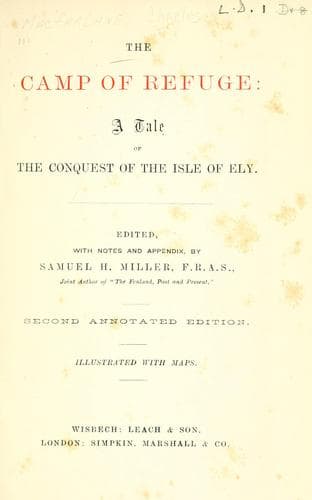
The Camp of Refuge: A Tale of the Conquest of the Isle of ElyMacFarlane, Charles
History
The Camp of Refuge: A Tale of the Conquest of the Isle of Ely
MacFarlane, Charles
Great Britain -- History -- Medieval period, 1066-1485 -- Fiction
under Roger Guiscard, the brother of Robert, and made prey of all that
fair island seven years before the son of the harlot of Falaise crossed
the Channel and came into England. Now Girolamo of Salerno had vowed
upon the relics of all the saints that were in the mother-church of
Salerno, that he would never live under the Norman tyranny; and sundry
of the Norman chiefs that went over with Roger Guiscard to Palermo had
vowed upon the crosses of their swords that they would hang him as a
dangerous man if they could but catch him. So Girolamo shook the dust
of Sicilie and Mongibel[120] from his feet, and, crossing the seas
again, went into Grecia. But go where he would, those incarnate devils
the Normans would be after him! He had not long lived in Grecia ere
Robert Guiscard came over from Otrantum and Brundisium, to spoil the
land and occupy it; therefore Girolamo fled again, cursing the Norman
lance. He had wandered long and far in the countries of the Orient: he
had visited the land of Egypt, he had been in Palestine, in Jerusalem,
in Bethlehem; he had stood and prayed on the spot where our Lord was
born, and on the spot where He was crucified; but, wearying of his
sojourn among Saracens, he had come back to the Christian west to see
if he could find some home where the hated Normans could not penetrate,
or where dwelt some brave Christian people that were hopeful of
fighting against those oppressors. He was roaming over the earth in
quest of enemies to the Normans when Hereward met him, two years ago,
in Flanders, and took his hand in his as a sworn foe to all men of that
race. Was, then, Girolamo of Salerno a likely man to be a spy or fautor
to the Normans in England? Thurstan acknowledged that he was not.
“But,” said he, “some men are so prone to suspicion that they suspect
everybody and everything that is near to them; and some men, nay, even
some monks and brothers of this very house, are so envious of my state
and such foes to my peace of mind, that whenever they see me more happy
and fuller of hope than common, they vamp me up some story or conjure
some spectrum to disquiet me and sadden me! Now, what said our prior
and cellarer no later than last night? They said, in the hearing of
many of this house, inexpert novices as well as cloister-monks, that
the dark stranger must be either an unbelieving Jew or a necromancer;
that when, at grand mass, the host was elevated in the church, he shot
glances of fire at it from his sharp eyes; and that when the service
was over they found him standing behind the high altar muttering what
sounded very like an incantation, in a tongue very like unto the Latin.”
Public-domain text, read in full here on John Shaqi.
Reviews
Reviews
No reviews yet
Be the first to share your thoughts on this work.
Elsewhere in the archive
Join the Discussion
Join the discussion
Sign in to leave a comment or review.
Sign InorCreate an account