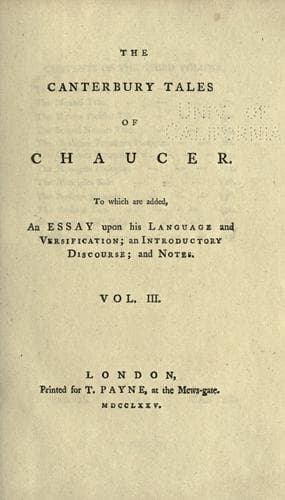
The Canterbury Tales, and Other PoemsChaucer, Geoffrey
ReligionChristian
The Canterbury Tales, and Other Poems
Chaucer, Geoffrey
Chaucer, Geoffrey, -1400; Christian pilgrims and pilgrimages -- Poetry; English poetry -- Middle English, 1100-1500
Our Host answer’d and said; “I grant it thee.
Roger, tell on; and look that it be good,
For many a pasty hast thou letten blood,
And many a Jack of Dover<1> hast thou sold,
That had been twice hot and twice cold.
Of many a pilgrim hast thou Christe’s curse,
For of thy parsley yet fare they the worse.
That they have eaten in thy stubble goose:
For in thy shop doth many a fly go loose.
Now tell on, gentle Roger, by thy name,
But yet I pray thee be not *wroth for game*; *angry with my jesting*
A man may say full sooth in game and play.”
“Thou sayst full sooth,” quoth Roger, “by my fay;
But sooth play quad play,<2> as the Fleming saith,
And therefore, Harry Bailly, by thy faith,
Be thou not wroth, else we departe* here, *part company
Though that my tale be of an hostelere.* *innkeeper
But natheless, I will not tell it yet,
But ere we part, y-wis* thou shalt be quit.”<3> *assuredly
And therewithal he laugh’d and made cheer,<4>
And told his tale, as ye shall after hear.
Notes to the Prologue to the Cook’s Tale
1. Jack of Dover: an article of cookery. (Transcriber’s note:
suggested by some commentators to be a kind of pie, and by
others to be a fish)
2. Sooth play quad play: true jest is no jest.
3. It may be remembered that each pilgrim was bound to tell
two stories; one on the way to Canterbury, the other returning.
4. Made cheer: French, “fit bonne mine;” put on a pleasant
countenance.
THE TALE.
A prentice whilom dwelt in our city,
And of a craft of victuallers was he:
Galliard* he was, as goldfinch in the shaw**, *lively **grove
Brown as a berry, a proper short fellaw:
With lockes black, combed full fetisly.* *daintily
And dance he could so well and jollily,
That he was called Perkin Revellour.
He was as full of love and paramour,
As is the honeycomb of honey sweet;
Well was the wenche that with him might meet.
At every bridal would he sing and hop;
He better lov’d the tavern than the shop.
For when there any riding was in Cheap,<1>
Out of the shoppe thither would he leap,
And, till that he had all the sight y-seen,
And danced well, he would not come again;
And gather’d him a meinie* of his sort, *company of fellows
To hop and sing, and make such disport:
And there they *sette steven* for to meet *made appointment*
To playen at the dice in such a street.
For in the towne was there no prentice
That fairer coulde cast a pair of dice
Than Perkin could; and thereto *he was free *he spent money liberally
Of his dispence, in place of privity.* where he would not be seen*
That found his master well in his chaffare,* *merchandise
For oftentime he found his box full bare.
For, soothely, a prentice revellour,
That haunteth dice, riot, and paramour,
His master shall it in his shop abie*, *suffer for
All* have he no part of the minstrelsy. *although
Public-domain text, read in full here on John Shaqi.
Reviews
Reviews
No reviews yet
Be the first to share your thoughts on this work.
Elsewhere in the archive
Join the Discussion
Join the discussion
Sign in to leave a comment or review.
Sign InorCreate an account