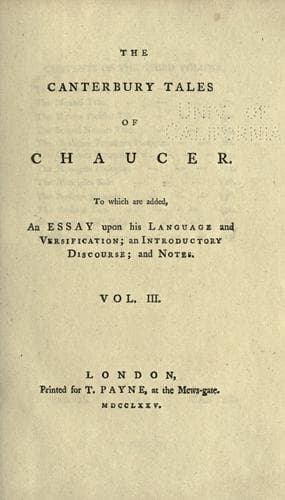
The Canterbury Tales, and Other PoemsChaucer, Geoffrey
ReligionChristian
The Canterbury Tales, and Other Poems
Chaucer, Geoffrey
Chaucer, Geoffrey, -1400; Christian pilgrims and pilgrimages -- Poetry; English poetry -- Middle English, 1100-1500
For theft and riot they be convertible,
All can they play on *gitern or ribible.* *guitar or rebeck*
Revel and truth, as in a low degree,
They be full wroth* all day, as men may see. *at variance
This jolly prentice with his master bode,
Till he was nigh out of his prenticehood,
All were he snubbed* both early and late, *rebuked
And sometimes led with revel to Newgate.
But at the last his master him bethought,
Upon a day when he his paper<2> sought,
Of a proverb, that saith this same word;
Better is rotten apple out of hoard,
Than that it should rot all the remenant:
So fares it by a riotous servant;
It is well lesse harm to let him pace*, *pass, go
Than he shend* all the servants in the place. *corrupt
Therefore his master gave him a quittance,
And bade him go, with sorrow and mischance.
And thus this jolly prentice had his leve*: *desire
Now let him riot all the night, or leave*. *refrain
And, for there is no thief without a louke,<3>
That helpeth him to wasten and to souk* *spend
Of that he bribe* can, or borrow may, *steal
Anon he sent his bed and his array
Unto a compere* of his owen sort, *comrade
That loved dice, and riot, and disport;
And had a wife, that held *for countenance* *for appearances*
A shop, and swived* for her sustenance. *prostituted herself
. . . . . . . <4>
Notes to the Cook’s Tale
1. Cheapside, where jousts were sometimes held, and which
was the great scene of city revels and processions.
2. His paper: his certificate of completion of his apprenticeship.
3. Louke: The precise meaning of the word is unknown, but it
is doubtless included in the cant term “pal”.
4. The Cook’s Tale is unfinished in all the manuscripts; but in
some, of minor authority, the Cook is made to break off his
tale, because “it is so foul,” and to tell the story of Gamelyn, on
which Shakespeare’s “As You Like It” is founded. The story is
not Chaucer’s, and is different in metre, and inferior in
composition to the Tales. It is supposed that Chaucer expunged
the Cook’s Tale for the same reason that made him on his death-
bed lament that he had written so much “ribaldry.”
THE MAN OF LAW’S TALE.
THE PROLOGUE.
Public-domain text, read in full here on John Shaqi.
Reviews
Reviews
No reviews yet
Be the first to share your thoughts on this work.
Elsewhere in the archive
Join the Discussion
Join the discussion
Sign in to leave a comment or review.
Sign InorCreate an account