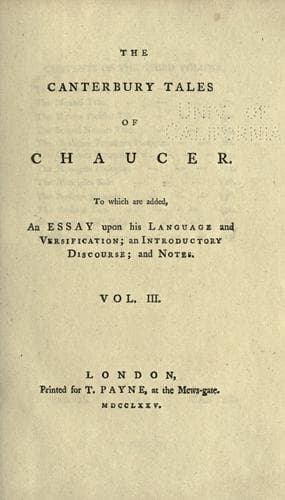
The Canterbury Tales, and Other PoemsChaucer, Geoffrey
ReligionChristian
The Canterbury Tales, and Other Poems
Chaucer, Geoffrey
Chaucer, Geoffrey, -1400; Christian pilgrims and pilgrimages -- Poetry; English poetry -- Middle English, 1100-1500
we may without violent effort believe that Chaucer speaks in his
own person, though dramatically the words are on the Clerk’s
lips. And the belief is not impaired by the sorrowful way in
which the Clerk lingers on Petrarch’s death — which would be
less intelligible if the fictitious narrator had only read the story
in the Latin translation, than if we suppose the news of
Petrarch’s death at Arqua in July 1374 to have closely followed
Chaucer to England, and to have cruelly and irresistibly mingled
itself with our poet’s personal recollections of his great Italian
contemporary. Nor must we regard as without significance the
manner in which the Clerk is made to distinguish between the
“body” of Petrarch’s tale, and the fashion in which it was set
forth in writing, with a proem that seemed “a thing
impertinent”, save that the poet had chosen in that way to
“convey his matter” — told, or “taught,” so much more directly
and simply by word of mouth. It is impossible to pronounce
positively on the subject; the question whether Chaucer saw
Petrarch in 1373 must remain a moot-point, so long as we have
only our present information; but fancy loves to dwell on the
thought of the two poets conversing under the vines at Arqua;
and we find in the history and the writings of Chaucer nothing
to contradict, a good deal to countenance, the belief that such a
meeting occurred.
Though we have no express record, we have indirect testimony,
that Chaucer’s Genoese mission was discharged satisfactorily;
for on the 23d of April 1374, Edward III grants at Windsor to
the poet, by the title of “our beloved squire” — dilecto Armigero
nostro — unum pycher. vini, “one pitcher of wine” daily, to be
“perceived” in the port of London; a grant which, on the
analogy of more modern usage, might he held equivalent to
Chaucer’s appointment as Poet Laureate. When we find that
soon afterwards the grant was commuted for a money payment
of twenty marks per annum, we need not conclude that
Chaucer’s circumstances were poor; for it may be easily
supposed that the daily “perception” of such an article of
income was attended with considerable prosaic inconvenience.
A permanent provision for Chaucer was made on the 8th of
June 1374, when he was appointed Controller of the Customs in
the Port of London, for the lucrative imports of wools, skins or
“wool-fells,” and tanned hides — on condition that he should
fulfil the duties of that office in person and not by deputy, and
should write out the accounts with his own hand. We have
what seems evidence of Chaucer’s compliance with these terms
in “The House of Fame”, where, in the mouth of the eagle, the
poet describes himself, when he has finished his labour and
made his reckonings, as not seeking rest and news in social
intercourse, but going home to his own house, and there, “all so
dumb as any stone,” sitting “at another book,” until his look is
dazed; and again, in the record that in 1376 he received a grant
of L731, 4s.
Public-domain text, read in full here on John Shaqi.
Reviews
Reviews
No reviews yet
Be the first to share your thoughts on this work.
Join the Discussion
Join the discussion
Sign in to leave a comment or review.
Sign InorCreate an account