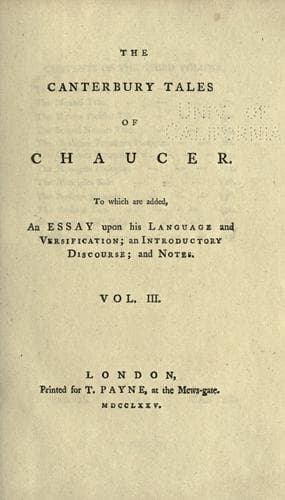
The Canterbury Tales, and Other PoemsChaucer, Geoffrey
ReligionChristian
The Canterbury Tales, and Other Poems
Chaucer, Geoffrey
Chaucer, Geoffrey, -1400; Christian pilgrims and pilgrimages -- Poetry; English poetry -- Middle English, 1100-1500
poet of Italy,” as the source whence the author has quoted.
When we consider the poet’s high place in literature and at
Court, which could not fail to make him free of the hospitalities
of the brilliant little Lombard States; his familiarity with the
tongue and the works of Italy’s greatest bards, dead and living;
the reverential regard which he paid to the memory of great
poets, of which we have examples in “The House of Fame,” and
at the close of “Troilus and Cressida” <4>; along with his own
testimony in the Prologue to The Clerk’s Tale, we cannot fail to
construe that testimony as a declaration that the Tale was
actually told to Chaucer by the lips of Petrarch, in 1373, the
very year in which Petrarch translated it into Latin, from
Boccaccio’s “Decameron.”<5> Mr Bell notes the objection to
this interpretation, that the words are put into the mouth, not of
the poet, but of the Clerk; and meets it by the counter-
objection, that the Clerk, being a purely imaginary personage,
could not have learned the story at Padua from Petrarch — and
therefore that Chaucer must have departed from the dramatic
assumption maintained in the rest of the dialogue. Instances
could be adduced from Chaucer’s writings to show that such a
sudden “departure from the dramatic assumption” would not be
unexampled: witness the “aside” in The Wife of Bath’s
Prologue, where, after the jolly Dame has asserted that “half so
boldly there can no man swear and lie as a woman can”, the
poet hastens to interpose, in his own person, these two lines:
“I say not this by wives that be wise,
But if it be when they them misadvise.”
And again, in the Prologue to the “Legend of Good Women,”
from a description of the daisy —
“She is the clearness and the very light,
That in this darke world me guides and leads,”
the poet, in the very next lines, slides into an address to his lady:
“The heart within my sorrowful heart you dreads
And loves so sore, that ye be, verily,
The mistress of my wit, and nothing I,” &c.
When, therefore, the Clerk of Oxford is made to say that he will
tell a tale —
“The which that I
Learn’d at Padova of a worthy clerk,
As proved by his wordes and his werk.
He is now dead, and nailed in his chest,
I pray to God to give his soul good rest.
Francis Petrarc’, the laureate poete,
Highte this clerk, whose rhetoric so sweet
Illumin’d all Itaile of poetry. . . .
But forth to tellen of this worthy man,
That taughte me this tale, as I began.” . . .
Public-domain text, read in full here on John Shaqi.
Reviews
Reviews
No reviews yet
Be the first to share your thoughts on this work.
Join the Discussion
Join the discussion
Sign in to leave a comment or review.
Sign InorCreate an account