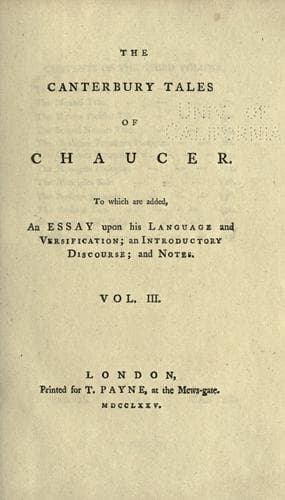
The Canterbury Tales, and Other PoemsChaucer, Geoffrey
ReligionChristian
The Canterbury Tales, and Other Poems
Chaucer, Geoffrey
Chaucer, Geoffrey, -1400; Christian pilgrims and pilgrimages -- Poetry; English poetry -- Middle English, 1100-1500
Chaucer is next found occupying a post which has not often
been held by men gifted with his peculiar genius — that of a
county member. The contest between the Dukes of Gloucester
and Lancaster, and their adherents, for the control of the
Government, was coming to a crisis; and when the recluse and
studious Chaucer was induced to offer himself to the electors of
Kent as one of the knights of their shire — where presumably he
held property — we may suppose that it was with the view of
supporting his patron’s cause in the impending conflict. The
Parliament in which the poet sat assembled at Westminster on
the 1st of October, and was dissolved on the 1st of November,
1386. Lancaster was fighting and intriguing abroad, absorbed in
the affairs of his Castilian succession; Gloucester and his friends
at home had everything their own way; the Earl of Suffolk was
dismissed from the woolsack, and impeached by the Commons;
and although Richard at first stood out courageously for the
friends of his uncle Lancaster, he was constrained, by the refusal
of supplies, to consent to the proceedings of Gloucester. A
commission was wrung from him, under protest, appointing
Gloucester, Arundel, and twelve other Peers and prelates, a
permanent council to inquire into the condition of all the public
departments, the courts of law, and the royal household, with
absolute powers of redress and dismissal. We need not ascribe
to Chaucer’s Parliamentary exertions in his patron’s behalf, nor
to any malpractices in his official conduct, the fact that he was
among the earliest victims of the commission.<9> In December
1386, he was dismissed from both his offices in the port of
London; but he retained his pensions, and drew them regularly
twice a year at the Exchequer until 1388. In 1387, Chaucer’s
political reverses were aggravated by a severe domestic
calamity: his wife died, and with her died the pension which had
been settled on her by Queen Philippa in 1366, and confirmed to
her at Richard’s accession in 1377. The change made in
Chaucer’s pecuniary position, by the loss of his offices and his
wife’s pension, must have been very great. It would appear that
during his prosperous times he had lived in a style quite equal to
his income, and had no ample resources against a season of
reverse; for, on the 1st of May 1388, less than a year and a half
after being dismissed from the Customs, he was constrained to
assign his pensions, by surrender in Chancery, to one John
Scalby. In May 1389, Richard II., now of age, abruptly
resumed the reins of government, which, for more than two
years, had been ably but cruelly managed by Gloucester. The
friends of Lancaster were once more supreme in the royal
councils, and Chaucer speedily profited by the change. On the
12th of July he was appointed Clerk of the King’s Works at the
Palace of Westminster, the Tower, the royal manors of
Kennington, Eltham, Clarendon, Sheen, Byfleet, Childern
Public-domain text, read in full here on John Shaqi.
Reviews
Reviews
No reviews yet
Be the first to share your thoughts on this work.
Join the Discussion
Join the discussion
Sign in to leave a comment or review.
Sign InorCreate an account