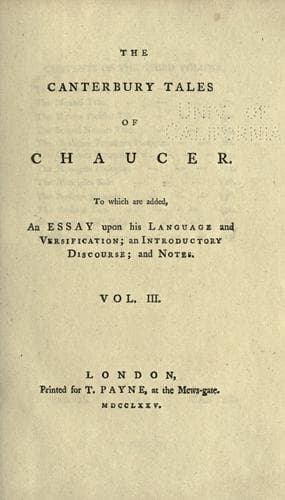
The Canterbury Tales, and Other Poems — John Shaqi
The Canterbury Tales, and Other PoemsChaucer, Geoffrey
ReligionChristian
The Canterbury Tales, and Other Poems
Chaucer, Geoffrey
Chaucer, Geoffrey, -1400; Christian pilgrims and pilgrimages -- Poetry; English poetry -- Middle English, 1100-1500
Langley, and Feckenham, the castle of Berkhamstead, the royal
lodge of Hathenburgh in the New Forest, the lodges in the
parks of Clarendon, Childern Langley, and Feckenham, and the
mews for the King’s falcons at Charing Cross; he received a
salary of two shillings per day, and was allowed to perform the
duties by deputy. For some reason unknown, Chaucer held this
lucrative office <10> little more than two years, quitting it
before the 16th of September 1391, at which date it had passed
into the hands of one John Gedney. The next two years and a
half are a blank, so far as authentic records are concerned;
Chaucer is supposed to have passed them in retirement,
probably devoting them principally to the composition of The
Canterbury Tales. In February 1394, the King conferred upon
him a grant of L20 a year for life; but he seems to have had no
other source of income, and to have become embarrassed by
debt, for frequent memoranda of small advances on his pension
show that his circumstances were, in comparison, greatly
reduced. Things appear to have grown worse and worse with
the poet; for in May 1398 he was compelled to obtain from the
King letters of protection against arrest, extending over a term
of two years. Not for the first time, it is true — for similar
documents had been issued at the beginning of Richard’s reign;
but at that time Chaucer’s missions abroad, and his responsible
duties in the port of London, may have furnished reasons for
securing him against annoyance or frivolous prosecution, which
were wholly wanting at the later date. In 1398, fortune began
again to smile upon him; he received a royal grant of a tun of
wine annually, the value being about L4. Next year, Richard II
having been deposed by the son of John of Gaunt <11> —
Henry of Bolingbroke, Duke of Lancaster — the new King, four
days after hits accession, bestowed on Chaucer a grant of forty
marks (L26, 13s. 4d.) per annum, in addition to the pension of
L20 conferred by Richard II. in 1394. But the poet, now
seventy-one years of age, and probably broken down by the
reverses of the past few years, was not destined long to enjoy
his renewed prosperity. On Christmas Eve of 1399, he entered
on the possession of a house in the garden of the Chapel of the
Blessed Mary of Westminster — near to the present site of
Henry VII.’s Chapel — having obtained a lease from Robert
Hermodesworth, a monk of the adjacent convent, for fifty-three
years, at the annual rent of four marks (L2, 13s. 4d.) Until the
1st of March 1400, Chaucer drew his pensions in person; then
they were received for him by another hand; and on the 25th of
October, in the same year, he died, at the age of seventy-two.
The only lights thrown by his poems on his closing days are
furnished in the little ballad called “Good Counsel of Chaucer,”
— which, though said to have been written when “upon his
death-bed lying in his great anguish, “breathes the very spirit of
Public-domain text, read in full here on John Shaqi.
Reviews
Reviews
No reviews yet
Be the first to share your thoughts on this work.
Join the Discussion
Join the discussion
Sign in to leave a comment or review.
Sign InorCreate an account