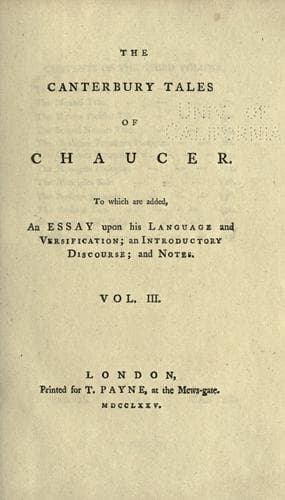
The Canterbury Tales, and Other PoemsChaucer, Geoffrey
ReligionChristian
The Canterbury Tales, and Other Poems
Chaucer, Geoffrey
Chaucer, Geoffrey, -1400; Christian pilgrims and pilgrimages -- Poetry; English poetry -- Middle English, 1100-1500
37. Unless we suppose this to be a namesake of the Camballo
who was Canace’s brother — which is not at all probable — we
must agree with Tyrwhitt that there is a mistake here; which no
doubt Chaucer would have rectified, if the tale had not been
“left half-told,” One manuscript reads “Caballo;” and though not
much authority need be given to a difference that may be due to
mere omission of the mark of contraction over the “a,” there is
enough in the text to show that another person than the king’s
younger son is intended. The Squire promises to tell the
adventures that befell each member of Cambuscan’s family; and
in thorough consistency with this plan, and with the canons of
chivalric story, would be “the marriage of Canace to some
knight who was first obliged to fight for her with her two
brethren; a method of courtship,” adds Tyrwhitt, “very
consonant to the spirit of ancient chivalry.”
38. (Trancriber’s note) In some manuscripts the following two
lines, being the beginning of the third part, are found: -
Apollo whirleth up his chair so high,
Till that Mercurius’ house, the sly…
THE FRANKLIN’S TALE.
THE PROLOGUE. <1>
“IN faith, Squier, thou hast thee well acquit,
And gentilly; I praise well thy wit,”
Quoth the Franklin; “considering thy youthe
So feelingly thou speak’st, Sir, I aloue* thee, *allow, approve
*As to my doom,* there is none that is here *so far as my judgment
Of eloquence that shall be thy peer, goes*
If that thou live; God give thee goode chance,
And in virtue send thee continuance,
For of thy speaking I have great dainty.* *value, esteem
I have a son, and, by the Trinity;
*It were me lever* than twenty pound worth land, *I would rather*
Though it right now were fallen in my hand,
He were a man of such discretion
As that ye be: fy on possession,
*But if* a man be virtuous withal. *unless
I have my sone snibbed* and yet shall, *rebuked; “snubbed.”
For he to virtue *listeth not t’intend,* *does not wish to
But for to play at dice, and to dispend, apply himself*
And lose all that he hath, is his usage;
And he had lever talke with a page,
Than to commune with any gentle wight,
There he might learen gentilless aright.”
Straw for your gentillesse!” quoth our Host.
“What? Frankelin, pardie, Sir, well thou wost* *knowest
That each of you must tellen at the least
A tale or two, or breake his behest.”* *promise
“That know I well, Sir,” quoth the Frankelin;
“I pray you have me not in disdain,
Though I to this man speak a word or two.”
“Tell on thy tale, withoute wordes mo’.”
“Gladly, Sir Host,” quoth he, “I will obey
Unto your will; now hearken what I say;
I will you not contrary* in no wise, *disobey
As far as that my wittes may suffice.
I pray to God that it may please you,
Then wot I well that it is good enow.
Public-domain text, read in full here on John Shaqi.
Reviews
Reviews
No reviews yet
Be the first to share your thoughts on this work.
Elsewhere in the archive
Join the Discussion
Join the discussion
Sign in to leave a comment or review.
Sign InorCreate an account