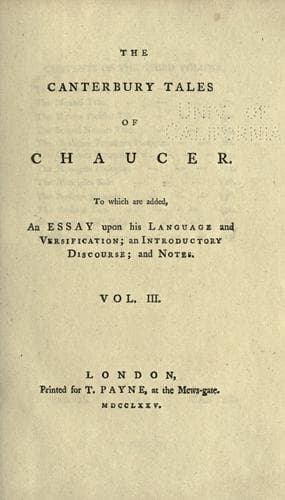
The Canterbury Tales, and Other PoemsChaucer, Geoffrey
ReligionChristian
The Canterbury Tales, and Other Poems
Chaucer, Geoffrey
Chaucer, Geoffrey, -1400; Christian pilgrims and pilgrimages -- Poetry; English poetry -- Middle English, 1100-1500
11. Chaucer’s patron had died earlier in 1399, during the exile
of his son (then Duke of Hereford) in France. The Duchess
Constance had died in 1394; and the Duke had made reparation
to Katherine Swynford — who had already borne him four
children — by marrying her in 1396, with the approval of
Richard II., who legitimated the children, and made the eldest
son of the poet’s sister-in-law Earl of Somerset. From this long-
illicit union sprang the house of Beaufort — that being the
surname of the Duke’s children by Katherine, after the name of
the castle in Anjou (Belfort, or Beaufort) where they were born.
12. Of Chaucer’s two sons by Philippa Roet, his only wife, the
younger, Lewis, for whom he wrote the Treatise on the
Astrolabe, died young. The elder, Thomas, married Maud, the
second daughter and co-heiress of Sir John Burghersh, brother
of the Bishop of Lincoln, the Chancellor and Treasurer of
England. By this marriage Thomas Chaucer acquired great
estates in Oxfordshire and elsewhere; and he figured
prominently in the second rank of courtiers for many years. He
was Chief Butler to Richard II.; under Henry IV. he was
Constable of Wallingford Castle, Steward of the Honours of
Wallingford and St Valery, and of the Chiltern Hundreds; and
the queen of Henry IV. granted him the farm of several of her
manors, a grant subsequently confirmed to him for life by the
King, after the Queen’s death. He sat in Parliament repeatedly
for Oxfordshire, was Speaker in 1414, and in the same year
went to France as commissioner to negotiate the marriage of
Henry V. with the Princess Katherine. He held, before he died
in 1434, various other posts of trust and distinction; but he left
no heirs-male. His only child, Alice Chaucer, married twice;
first Sir John Philip; and afterwards the Duke of Suffolk —
attainted and beheaded in 1450. She had three children by the
Duke; and her eldest son married the Princess Elizabeth, sister
of Edward IV. The eldest son of this marriage, created Earl of
Lincoln, was declared by Richard III heir-apparent to the
throne, in case the Prince of Wales should die without issue; but
the death of Lincoln himself, at the battle of Stoke in 1487,
destroyed all prospect that the poet’s descendants might
succeed to the crown of England; and his family is now believed
to be extinct.
13. “Geoffrey Chaucer, bard, and famous mother of poetry, is
buried in this sacred ground.”
14. Railings.
15 Translation of the epitaph: This tomb was built for Geoffrey
Chaucer, who in his time was the greatest poet of the English. If
you ask the year of his death, behold the words beneath, which
tell you all. Death gave him rest from his toil, 25th of October
1400. N Brigham bore the cost of these words in the name of
the Muses. 1556.
16. See the Prologue to Chaucer’s Tale of Sir Thopas.
17. See the “Goodly Ballad of Chaucer,” seventh stanza.
Public-domain text, read in full here on John Shaqi.
Reviews
Reviews
No reviews yet
Be the first to share your thoughts on this work.
Join the Discussion
Join the discussion
Sign in to leave a comment or review.
Sign InorCreate an account