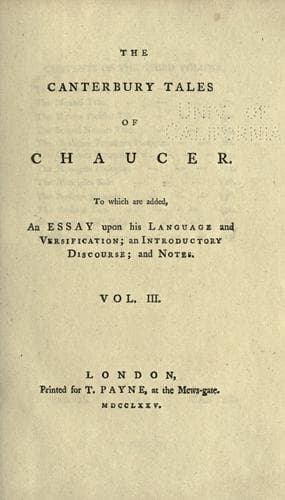
The Canterbury Tales, and Other Poems — John Shaqi
The Canterbury Tales, and Other PoemsChaucer, Geoffrey
ReligionChristian
The Canterbury Tales, and Other Poems
Chaucer, Geoffrey
Chaucer, Geoffrey, -1400; Christian pilgrims and pilgrimages -- Poetry; English poetry -- Middle English, 1100-1500
8. The old biographers of Chaucer, founding on what they took
to be autobiographic allusions in “The Testament of Love,”
assign to him between 1354 and 1389 a very different history
from that here given on the strength of authentic records
explored and quoted by Sir H. Nicolas. Chaucer is made to
espouse the cause of John of Northampton, the Wycliffite Lord
Mayor of London, whose re-election in 1384 was so
vehemently opposed by the clergy, and who was imprisoned in
the sequel of the grave disorders that arose. The poet, it is said,
fled to the Continent, taking with him a large sum of money,
which he spent in supporting companions in exile; then,
returning by stealth to England in quest of funds, he was
detected and sent to the Tower, where he languished for three
years, being released only on the humiliating condition of
informing against his associates in the plot. The public records
show, however, that, all the time of his alleged exile and
captivity, he was quietly living in London, regularly drawing his
pensions in person, sitting in Parliament, and discharging his
duties in the Customs until his dismissal in 1386. It need not be
said, further, that although Chaucer freely handled the errors,
the ignorance, and vices of the clergy, he did so rather as a man
of sense and of conscience, than as a Wycliffite — and there is
no evidence that he espoused the opinions of the zealous
Reformer, far less played the part of an extreme and self-
regardless partisan of his old friend and college-companion.
9. “The Commissioners appear to have commenced their
labours with examining the accounts of the officers employed in
the collection of the revenue; and the sequel affords a strong
presumption that the royal administration [under Lancaster and
his friends] had been foully calumniated. We hear not of any
frauds discovered, or of defaulters punished, or of grievances
redressed.” Such is the testimony of Lingard (chap. iv., 1386),
all the more valuable for his aversion from the Wycliffite
leanings of John of Gaunt. Chaucer’s department in the London
Customs was in those days one of the most important and
lucrative in the kingdom; and if mercenary abuse of his post
could have been proved, we may be sure that his and his
patron’s enemies would not have been content with simple
dismissal, but would have heavily amerced or imprisoned him.
10. The salary was L36, 10s. per annum; the salary of the Chief
Judges was L40, of the Puisne Judges about L27. Probably the
Judges — certainly the Clerk of the Works — had fees or
perquisites besides the stated payment.
Public-domain text, read in full here on John Shaqi.
Reviews
Reviews
No reviews yet
Be the first to share your thoughts on this work.
Join the Discussion
Join the discussion
Sign in to leave a comment or review.
Sign InorCreate an account