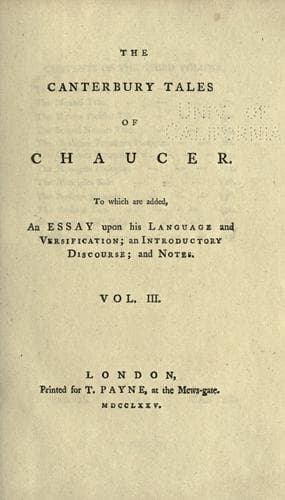
The Canterbury Tales, and Other PoemsChaucer, Geoffrey
ReligionChristian
The Canterbury Tales, and Other Poems
Chaucer, Geoffrey
Chaucer, Geoffrey, -1400; Christian pilgrims and pilgrimages -- Poetry; English poetry -- Middle English, 1100-1500
As regards the manner in which the text of the two great works,
especially of The Canterbury Tales, is presented, the Editor is
aware that some whose judgement is weighty will differ from
him. This volume has been prepared “for popular perusal;” and
its very _raison d’être_ would have failed, if the ancient
orthography had been retained. It has often been affirmed by
editors of Chaucer in the old forms of the language, that a little
trouble at first would render the antiquated spelling and
obsolete inflections a continual source, not of difficulty, but of
actual delight, for the reader coming to the study of Chaucer
without any preliminary acquaintance with the English of his
day — or of his copyists’ days. Despite this complacent
assurance, the obvious fact is, that Chaucer in the old forms has
not become popular, in the true sense of the word; he is not
“understanded of the vulgar.” In this volume, therefore, the text
of Chaucer has been presented in nineteenth-century garb. But
there has been not the slightest attempt to “modernise”
Chaucer, in the wider meaning of the phrase; to replace his
words by words which he did not use; or, following the example
of some operators, to translate him into English of the modern
spirit as well as the modern forms. So far from that, in every
case where the old spelling or form seemed essential to metre,
to rhyme, or meaning, no change has been attempted. But,
wherever its preservation was not essential, the spelling of the
monkish transcribers — for the most ardent purist must now
despair of getting at the spelling of Chaucer himself — has been
discarded for that of the reader’s own day. It is a poor
compliment to the Father of English Poetry, to say that by such
treatment the bouquet and individuality of his works must be
lost. If his masterpiece is valuable for one thing more than any
other, it is the vivid distinctness with which English men and
women of the fourteenth century are there painted, for the study
of all the centuries to follow. But we wantonly balk the artist’s
own purpose, and discredit his labour, when we keep before his
picture the screen of dust and cobwebs which, for the English
people in these days, the crude forms of the infant language
have practically become. Shakespeare has not suffered by
similar changes; Spencer has not suffered; it would be surprising
if Chaucer should suffer, when the loss of popular
comprehension and favour in his case are necessarily all the
greater for his remoteness from our day. In a much smaller
degree — since previous labours in the same direction had left
far less to do — the same work has been performed for the
spelling of Spenser; and the whole endeavour in this department
of the Editor’s task has been, to present a text plain and easily
intelligible to the modern reader, without any injustice to the old
poet. It would be presumptuous to believe that in every case
both ends have been achieved together; but the laudatores
Public-domain text, read in full here on John Shaqi.
Reviews
Reviews
No reviews yet
Be the first to share your thoughts on this work.
Join the Discussion
Join the discussion
Sign in to leave a comment or review.
Sign InorCreate an account