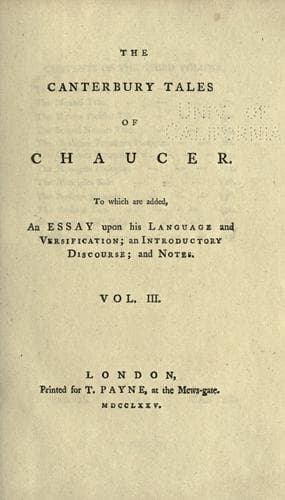
The Canterbury Tales, and Other Poems — John Shaqi
The Canterbury Tales, and Other PoemsChaucer, Geoffrey
ReligionChristian
The Canterbury Tales, and Other Poems
Chaucer, Geoffrey
Chaucer, Geoffrey, -1400; Christian pilgrims and pilgrimages -- Poetry; English poetry -- Middle English, 1100-1500
temporis acti - the students who may differ most from the plan
pursued in this volume — will best appreciate the difficulty of
the enterprise, and most leniently regard any failure in the
details of its accomplishment.
With all the works of Chaucer, outside The Canterbury Tales, it
would have been absolutely impossible to deal within the scope
of this volume. But nearly one hundred pages, have been
devoted to his minor poems; and, by dint of careful selection
and judicious abridgement — a connecting outline of the story in
all such cases being given — the Editor ventures to hope that he
has presented fair and acceptable specimens of Chaucer’s
workmanship in all styles. The preparation of this part of the
volume has been a laborious task; no similar attempt on the
same scale has been made; and, while here also the truth of the
text in matters essential has been in nowise sacrificed to mere
ease of perusal, the general reader will find opened up for him a
new view of Chaucer and his works. Before a perusal of these
hundred pages, will melt away for ever the lingering tradition or
prejudice that Chaucer was only, or characteristically, a coarse
buffoon, who pandered to a base and licentious appetite by
painting and exaggerating the lowest vices of his time. In these
selections — made without a thought of taking only what is to
the poet’s credit from a wide range of poems in which hardly a
word is to his discredit — we behold Chaucer as he was; a
courtier, a gallant, pure-hearted gentleman, a scholar, a
philosopher, a poet of gay and vivid fancy, playing around
themes of chivalric convention, of deep human interest, or
broad-sighted satire. In The Canterbury Tales, we see, not
Chaucer, but Chaucer’s times and neighbours; the artist has lost
himself in his work. To show him honestly and without disguise,
as he lived his own life and sung his own songs at the brilliant
Court of Edward III, is to do his memory a moral justice far
more material than any wrong that can ever come out of
spelling. As to the minor poems of Spenser, which follow The
Faerie Queen, the choice has been governed by the desire to
give at once the most interesting, and the most characteristic of
the poet’s several styles; and, save in the case of the Sonnets,
the poems so selected are given entire. It is manifest that the
endeavours to adapt this volume for popular use, have been
already noticed, would imperfectly succeed without the aid of
notes and glossary, to explain allusions that have become
obsolete, or antiquated words which it was necessary to retain.
An endeavour has been made to render each page self-
explanatory, by placing on it all the glossarial and illustrative
notes required for its elucidation, or — to avoid repetitions that
would have occupied space — the references to the spot where
information may be found. The great advantage of such a plan
to the reader, is the measure of its difficulty for the editor. It
Public-domain text, read in full here on John Shaqi.
Reviews
Reviews
No reviews yet
Be the first to share your thoughts on this work.
Join the Discussion
Join the discussion
Sign in to leave a comment or review.
Sign InorCreate an account