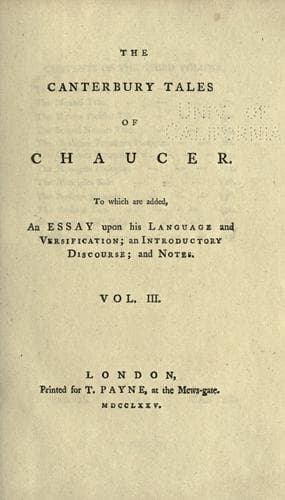
The Canterbury Tales, and Other PoemsChaucer, Geoffrey
ReligionChristian
The Canterbury Tales, and Other Poems
Chaucer, Geoffrey
Chaucer, Geoffrey, -1400; Christian pilgrims and pilgrimages -- Poetry; English poetry -- Middle English, 1100-1500
Like his great successor, Spencer, it was the fortune of Chaucer
to live under a splendid, chivalrous, and high-spirited reign.
1328 was the second year of Edward III; and, what with Scotch
wars, French expeditions, and the strenuous and costly struggle
to hold England in a worthy place among the States of Europe,
there was sufficient bustle, bold achievement, and high ambition
in the period to inspire a poet who was prepared to catch the
spirit of the day. It was an age of elaborate courtesy, of high-
paced gallantry, of courageous venture, of noble disdain for
mean tranquillity; and Chaucer, on the whole a man of peaceful
avocations, was penetrated to the depth of his consciousness
with the lofty and lovely civil side of that brilliant and restless
military period. No record of his youthful years, however,
remains to us; if we believe that at the age of eighteen he was a
student of Cambridge, it is only on the strength of a reference in
his “Court of Love”, where the narrator is made to say that his
name is Philogenet, “of Cambridge clerk;” while he had already
told us that when he was stirred to seek the Court of Cupid he
was “at eighteen year of age.” According to Leland, however,
he was educated at Oxford, proceeding thence to France and
the Netherlands, to finish his studies; but there remains no
certain evidence of his having belonged to either University. At
the same time, it is not doubted that his family was of good
condition; and, whether or not we accept the assertion that his
father held the rank of knighthood — rejecting the hypotheses
that make him a merchant, or a vintner “at the corner of Kirton
Lane” — it is plain, from Chaucer’s whole career, that he had
introductions to public life, and recommendations to courtly
favour, wholly independent of his genius. We have the clearest
testimony that his mental training was of wide range and
thorough excellence, altogether rare for a mere courtier in those
days: his poems attest his intimate acquaintance with the
divinity, the philosophy, and the scholarship of his time, and
show him to have had the sciences, as then developed and
taught, “at his fingers’ ends.” Another proof of Chaucer’s good
birth and fortune would he found in the statement that, after his
University career was completed, he entered the Inner Temple -
- the expenses of which could be borne only by men of noble
and opulent families; but although there is a story that he was
once fined two shillings for thrashing a Franciscan friar in Fleet
Street, we have no direct authority for believing that the poet
devoted himself to the uncongenial study of the law. No special
display of knowledge on that subject appears in his works; yet
in the sketch of the Manciple, in the Prologue to the Canterbury
Tales, may be found indications of his familiarity with the
internal economy of the Inns of Court; while numerous legal
phrases and references hint that his comprehensive information
was not at fault on legal matters.
Public-domain text, read in full here on John Shaqi.
Reviews
Reviews
No reviews yet
Be the first to share your thoughts on this work.
Join the Discussion
Join the discussion
Sign in to leave a comment or review.
Sign InorCreate an account