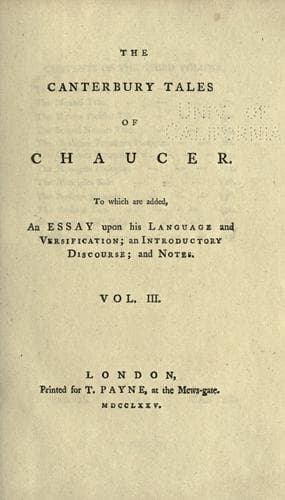
The Canterbury Tales, and Other PoemsChaucer, Geoffrey
ReligionChristian
The Canterbury Tales, and Other Poems
Chaucer, Geoffrey
Chaucer, Geoffrey, -1400; Christian pilgrims and pilgrimages -- Poetry; English poetry -- Middle English, 1100-1500
Leland says that he quitted the
University “a ready logician, a smooth rhetorician, a pleasant
poet, a grave philosopher, an ingenious mathematician, and a
holy divine;” and by all accounts, when Geoffrey Chaucer
comes before us authentically for the first time, at the age of
thirty-one, he was possessed of knowledge and
accomplishments far beyond the common standard of his day.
Chaucer at this period possessed also other qualities fitted to
recommend him to favour in a Court like that of Edward III.
Urry describes him, on the authority of a portrait, as being then
“of a fair beautiful complexion, his lips red and full, his size of a
just medium, and his port and air graceful and majestic. So,”
continues the ardent biographer, — “so that every ornament that
could claim the approbation of the great and fair, his abilities to
record the valour of the one, and celebrate the beauty of the
other, and his wit and gentle behaviour to converse with both,
conspired to make him a complete courtier.” If we believe that
his “Court of Love” had received such publicity as the literary
media of the time allowed in the somewhat narrow and select
literary world — not to speak of “Troilus and Cressida,” which,
as Lydgate mentions it first among Chaucer’s works, some have
supposed to be a youthful production — we find a third and not
less powerful recommendation to the favour of the great co-
operating with his learning and his gallant bearing. Elsewhere
<2> reasons have been shown for doubt whether “Troilus and
Cressida” should not be assigned to a later period of Chaucer’s
life; but very little is positively known about the dates and
sequence of his various works. In the year 1386, being called as
witness with regard to a contest on a point of heraldry between
Lord Scrope and Sir Robert Grosvenor, Chaucer deposed that
he entered on his military career in 1359. In that year Edward
III invaded France, for the third time, in pursuit of his claim to
the French crown; and we may fancy that, in describing the
embarkation of the knights in “Chaucer’s Dream”, the poet
gained some of the vividness and stir of his picture from his
recollections of the embarkation of the splendid and well-
appointed royal host at Sandwich, on board the eleven hundred
transports provided for the enterprise. In this expedition the
laurels of Poitiers were flung on the ground; after vainly
attempting Rheims and Paris, Edward was constrained, by cruel
weather and lack of provisions, to retreat toward his ships; the
fury of the elements made the retreat more disastrous than an
overthrow in pitched battle; horses and men perished by
thousands, or fell into the hands of the pursuing French.
Chaucer, who had been made prisoner at the siege of Retters,
was among the captives in the possession of France when the
treaty of Bretigny — the “great peace” — was concluded, in
May, 1360. Returning to England, as we may suppose, at the
peace, the poet, ere long, fell into another and a pleasanter
Public-domain text, read in full here on John Shaqi.
Reviews
Reviews
No reviews yet
Be the first to share your thoughts on this work.
Join the Discussion
Join the discussion
Sign in to leave a comment or review.
Sign InorCreate an account