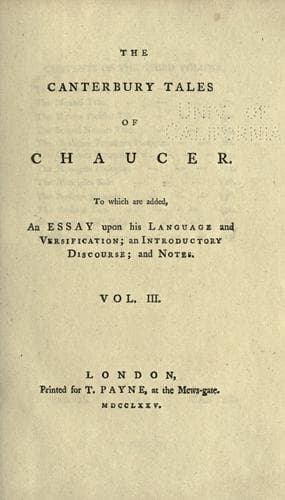
The Canterbury Tales, and Other PoemsChaucer, Geoffrey
ReligionChristian
The Canterbury Tales, and Other Poems
Chaucer, Geoffrey
Chaucer, Geoffrey, -1400; Christian pilgrims and pilgrimages -- Poetry; English poetry -- Middle English, 1100-1500
*believe me*
For gentle mercy *oweth to passen right*.” *ought to be rightly
Then said he thus to Palamon the knight; directed*
“I trow there needeth little sermoning
To make you assente to this thing.
Come near, and take your lady by the hand.”
Betwixte them was made anon the band,
That hight matrimony or marriage,
By all the counsel of the baronage.
And thus with alle bliss and melody
Hath Palamon y-wedded Emily.
And God, that all this wide world hath wrought,
Send him his love, that hath it dearly bought.
For now is Palamon in all his weal,
Living in bliss, in riches, and in heal*. *health
And Emily him loves so tenderly,
And he her serveth all so gentilly,
That never was there worde them between
Of jealousy, nor of none other teen*. *cause of anger
Thus endeth Palamon and Emily
And God save all this faire company.
Notes to The Knight’s Tale.
1. For the plan and principal incidents of the “Knight’s Tale,”
Chaucer was indebted to Boccaccio, who had himself borrowed
from some prior poet, chronicler, or romancer. Boccaccio
speaks of the story as “very ancient;” and, though that may not
be proof of its antiquity, it certainly shows that he took it from
an earlier writer. The “Tale” is more or less a paraphrase of
Boccaccio’s “Theseida;” but in some points the copy has a
distinct dramatic superiority over the original. The “Theseida”
contained ten thousand lines; Chaucer has condensed it into less
than one-fourth of the number. The “Knight’s Tale” is supposed
to have been at first composed as a separate work; it is
undetermined whether Chaucer took it direct from the Italian of
Boccaccio, or from a French translation.
2. Highte: was called; from the Anglo-Saxon “hatan”, to bid or
call; German, “Heissen”, “heisst”.
3. Feminie: The “Royaume des Femmes” — kingdom of the
Amazons. Gower, in the “Confessio Amantis,” styles
Penthesilea the “Queen of Feminie.”
4. Wonnen: Won, conquered; German “gewonnen.”
5. Ear: To plough; Latin, “arare.” “I have abundant matter for
discourse.” The first, and half of the second, of Boccaccio’s
twelve books are disposed of in the few lines foregoing.
6. Waimenting: bewailing; German, “wehklagen”
7. Starf: died; German, “sterben,” “starb”.
8. The Minotaur: The monster, half-man and half-bull, which
yearly devoured a tribute of fourteen Athenian youths and
maidens, until it was slain by Theseus.
9. Pillers: pillagers, strippers; French, “pilleurs.”
10. The donjon was originally the central tower or “keep” of
feudal castles; it was employed to detain prisoners of
importance. Hence the modern meaning of the word dungeon.
11. Saturn, in the old astrology, was a most unpropitious star to
be born under.
Public-domain text, read in full here on John Shaqi.
Reviews
Reviews
No reviews yet
Be the first to share your thoughts on this work.
Elsewhere in the archive
Join the Discussion
Join the discussion
Sign in to leave a comment or review.
Sign InorCreate an account