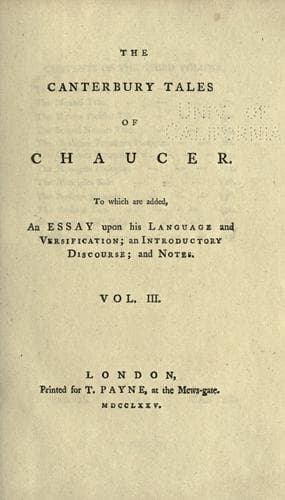
The Canterbury Tales, and Other PoemsChaucer, Geoffrey
ReligionChristian
The Canterbury Tales, and Other Poems
Chaucer, Geoffrey
Chaucer, Geoffrey, -1400; Christian pilgrims and pilgrimages -- Poetry; English poetry -- Middle English, 1100-1500
12. To die in the pain was a proverbial expression in the French,
used as an alternative to enforce a resolution or a promise.
Edward III., according to Froissart, declared that he would
either succeed in the war against France or die in the pain —
“Ou il mourroit en la peine.” It was the fashion in those times to
swear oaths of friendship and brotherhood; and hence, though
the fashion has long died out, we still speak of “sworn friends.”
13. The saying of the old scholar Boethius, in his treatise “De
Consolatione Philosophiae”, which Chaucer translated, and
from which he has freely borrowed in his poetry. The words are
“Quis legem det amantibus?
Major lex amor est sibi.”
(“Who can give law to lovers? Love is a law unto himself, and
greater”)
14. “Perithous” and “Theseus” must, for the metre, be
pronounced as words of four and three syllables respectively —
the vowels at the end not being diphthongated, but enunciated
separately, as if the words were printed Pe-ri-tho-us, The-se-us.
The same rule applies in such words as “creature” and
“conscience,” which are trisyllables.
15. Stound: moment, short space of time; from Anglo-Saxon,
“stund;” akin to which is German, “Stunde,” an hour.
16. Meinie: servants, or menials, &c., dwelling together in a
house; from an Anglo-Saxon word meaning a crowd. Compare
German, “Menge,” multitude.
17. The pure fetters: the very fetters. The Greeks used
“katharos”, the Romans “purus,” in the same sense.
18. In the medieval courts of Love, to which allusion is
probably made forty lines before, in the word “parlement,” or
“parliament,” questions like that here proposed were seriously
discussed.
19. Gear: behaviour, fashion, dress; but, by another reading, the
word is “gyre,” and means fit, trance — from the Latin, “gyro,” I
turn round.
20. Before his head in his cell fantastic: in front of his head in
his cell of fantasy. “The division of the brain into cells,
according to the different sensitive faculties,” says Mr Wright,
“is very ancient, and is found depicted in mediaeval
manuscripts.” In a manuscript in the Harleian Library, it is
stated, “Certum est in prora cerebri esse fantasiam, in medio
rationem discretionis, in puppi memoriam” (it is certain that in
the front of the brain is imagination, in the middle reason, in the
back memory) — a classification not materially differing from
that of modern phrenologists.
21. Dan: Lord; Latin, “Dominus;” Spanish, “Don.”
22. The “caduceus.”
23. Argus was employed by Juno to watch Io with his hundred
eyes but he was sent to sleep by the flute of Mercury, who then
cut off his head.
24. Next: nearest; German, “naechste”.
25. Clary: hippocras, wine made with spices.
26. Warray: make war; French “guerroyer”, to molest; hence,
perhaps, “to worry.”
27. All day meeten men at unset steven: every day men meet at
unexpected time. “To set a steven,” is to fix a time, make an
appointment.
28. Roundelay: song coming round again to the words with
which it opened.
Public-domain text, read in full here on John Shaqi.
Reviews
Reviews
No reviews yet
Be the first to share your thoughts on this work.
Elsewhere in the archive
Join the Discussion
Join the discussion
Sign in to leave a comment or review.
Sign InorCreate an account