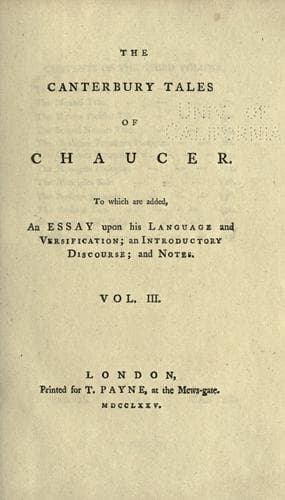
The Canterbury Tales, and Other PoemsChaucer, Geoffrey
ReligionChristian
The Canterbury Tales, and Other Poems
Chaucer, Geoffrey
Chaucer, Geoffrey, -1400; Christian pilgrims and pilgrimages -- Poetry; English poetry -- Middle English, 1100-1500
29. Now in the crop and now down in the breres: Now in the
tree-top, now down in the briars. “Crop and root,” top and
bottom, is used to express the perfection or totality of anything.
30. Beknow: avow, acknowledge: German, “bekennen.”
31. Shapen was my death erst than my shert: My death was
decreed before my shirt ws shaped — that is, before any clothes
were made for me, before my birth.
32. Regne: Queen; French, “Reine;” Venus is meant. The
common reading, however, is “regne,” reign or power.
33. Launde: plain. Compare modern English, “lawn,” and
French, “Landes” — flat, bare marshy tracts in the south of
France.
34. Mister: manner, kind; German “muster,” sample, model.
35. In listes: in the lists, prepared for such single combats
between champion and accuser, &c.
36. Thilke: that, contracted from “the ilke,” the same.
37. Mars the Red: referring to the ruddy colour of the planet, to
which was doubtless due the transference to it of the name of
the God of War. In his “Republic,” enumerating the seven
planets, Cicero speaks of the propitious and beneficent light of
Jupiter: “Tum (fulgor) rutilis horribilisque terris, quem Martium
dicitis” — “Then the red glow, horrible to the nations, which
you say to be that of Mars.” Boccaccio opens the “Theseida” by
an invocation to “rubicondo Marte.”
38. Last: lace, leash, noose, snare: from Latin, “laceus.”
39. “Round was the shape, in manner of compass,
Full of degrees, the height of sixty pas”
The building was a circle of steps or benches, as in the ancient
amphitheatre. Either the building was sixty paces high; or, more
probably, there were sixty of the steps or benches.
40. Yellow goldes: The sunflower, turnsol, or girasol, which
turns with and seems to watch the sun, as a jealous lover his
mistress.
41. Citheron: The Isle of Venus, Cythera, in the Aegean Sea;
now called Cerigo: not, as Chaucer’s form of the word might
imply, Mount Cithaeron, in the south-west of Boetia, which was
appropriated to other deities than Venus — to Jupiter, to
Bacchus, and the Muses.
42. It need not be said that Chaucer pays slight heed to
chronology in this passage, where the deeds of Turnus, the
glory of King Solomon, and the fate of Croesus are made
memories of the far past in the time of fabulous Theseus, the
Minotaur-slayer.
43. Champartie: divided power or possession; an old law-term,
signifying the maintenance of a person in a law suit on the
condition of receiving part of the property in dispute, if
recovered.
44. Citole: a kind of dulcimer.
45. The picke-purse: The plunderers that followed armies, and
gave to war a horror all their own.
46. Shepen: stable; Anglo-Saxon, “scypen;” the word
“sheppon” still survives in provincial parlance.
47. This line, perhaps, refers to the deed of Jael.
Public-domain text, read in full here on John Shaqi.
Reviews
Reviews
No reviews yet
Be the first to share your thoughts on this work.
Elsewhere in the archive
Join the Discussion
Join the discussion
Sign in to leave a comment or review.
Sign InorCreate an account