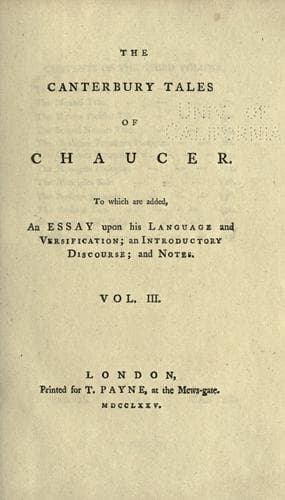
The Canterbury Tales, and Other PoemsChaucer, Geoffrey
ReligionChristian
The Canterbury Tales, and Other Poems
Chaucer, Geoffrey
Chaucer, Geoffrey, -1400; Christian pilgrims and pilgrimages -- Poetry; English poetry -- Middle English, 1100-1500
48. The shippes hoppesteres: The meaning is dubious. We may
understand “the dancing ships,” “the ships that hop” on the
waves; “steres” being taken as the feminine adjectival
termination: or we may, perhaps, read, with one of the
manuscripts, “the ships upon the steres” — that is, even as they
are being steered, or on the open sea — a more picturesque
notion.
49. Freting: devouring; the Germans use “Fressen” to mean
eating by animals, “essen” by men.
50. Julius: i.e. Julius Caesar
51. Puella and Rubeus were two figures in geomancy,
representing two constellations-the one signifying Mars
retrograde, the other Mars direct.
52. Calistope: or Callisto, daughter of Lycaon, seduced by
Jupiter, turned into a bear by Diana, and placed afterwards, with
her son, as the Great Bear among the stars.
53. Dane: Daphne, daughter of the river-god Peneus, in
Thessaly; she was beloved by Apollo, but to avoid his pursuit,
she was, at her own prayer, changed into a laurel-tree.
54. As the goddess of Light, or the goddess who brings to light,
Diana — as well as Juno — was invoked by women in childbirth:
so Horace, Odes iii. 22, says:—
“Montium custos nemorumque, Virgo,
Quae laborantes utero puellas
Ter vocata audis adimisque leto,
Diva triformis.”
(“Virgin custodian of hills and groves, three-formed goddess
who hears and saves from death young women who call upon
her thrice when in childbirth”)
55. Every deal: in every part; “deal” corresponds to the
German “Theil” a portion.
56. Sikerly: surely; German, “sicher;” Scotch, “sikkar,” certain.
When Robert Bruce had escaped from England to assume the
Scottish crown, he stabbed Comyn before the altar at Dumfries;
and, emerging from the church, was asked by his friend
Kirkpatrick if he had slain the traitor. “I doubt it,” said Bruce.
“Doubt,” cried Kirkpatrick. “I’ll mak sikkar;” and he rushed
into the church, and despatched Comyn with repeated thrusts of
his dagger.
57. Kemped: combed; the word survives in “unkempt.”
58. Alauns: greyhounds, mastiffs; from the Spanish word
“Alano,” signifying a mastiff.
59. Y-ment: mixed; German, “mengen,” to mix.
60. Prime: The time of early prayers, between six and nine in
the morning.
61. On the dais: see note 32 to the Prologue.
62. In her hour: in the hour of the day (two hours before
daybreak) which after the astrological system that divided the
twenty-four among the seven ruling planets, was under the
influence of Venus.
63. Adon: Adonis, a beautiful youth beloved of Venus, whose
death by the tusk of a boar she deeply mourned.
64. The third hour unequal: In the third planetary hour;
Palamon had gone forth in the hour of Venus, two hours before
daybreak; the hour of Mercury intervened; the third hour was
that of Luna, or Diana. “Unequal” refers to the astrological
division of day and night, whatever their duration, into twelve
parts, which of necessity varied in length with the season.
Public-domain text, read in full here on John Shaqi.
Reviews
Reviews
No reviews yet
Be the first to share your thoughts on this work.
Elsewhere in the archive
Join the Discussion
Join the discussion
Sign in to leave a comment or review.
Sign InorCreate an account