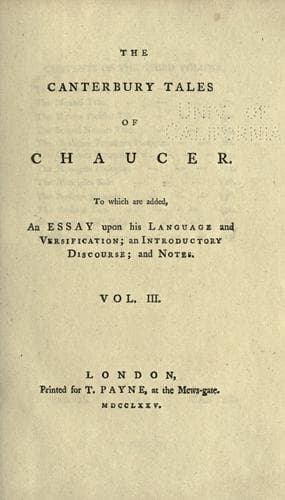
The Canterbury Tales, and Other PoemsChaucer, Geoffrey
ReligionChristian
The Canterbury Tales, and Other Poems
Chaucer, Geoffrey
Chaucer, Geoffrey, -1400; Christian pilgrims and pilgrimages -- Poetry; English poetry -- Middle English, 1100-1500
65. Smoking: draping; hence the word “smock;” “smokless,” in
Chaucer, means naked.
66. Cerrial: of the species of oak which Pliny, in his “Natural
History,” calls “cerrus.”
67. Stace of Thebes: Statius, the Roman who embodied in the
twelve books of his “Thebaid” the ancient legends connected
with the war of the seven against Thebes.
68. Diana was Luna in heaven, Diana on earth, and Hecate in
hell; hence the direction of the eyes of her statue to “Pluto’s
dark region.” Her statue was set up where three ways met, so
that with a different face she looked down each of the three;
from which she was called Trivia. See the quotation from
Horace, note 54.
69. Las: net; the invisible toils in which Hephaestus caught Ares
and the faithless Aphrodite, and exposed them to the
“inextinguishable laughter” of Olympus.
70. Saturnus the cold: Here, as in “Mars the Red” we have the
person of the deity endowed with the supposed quality of the
planet called after his name.
71. The astrologers ascribed great power to Saturn, and
predicted “much debate” under his ascendancy; hence it was
“against his kind” to compose the heavenly strife.
72. Ayel: grandfather; French “Aieul”.
73. Testers: Helmets; from the French “teste”, “tete”, head.
74. Parements: ornamental garb, French “parer” to deck.
75. Gniding: Rubbing, polishing; Anglo-Saxon “gnidan”, to rub.
76. Nakeres: Drums, used in the cavalry; Boccaccio’s word is
“nachere”.
77. Made an O: Ho! Ho! to command attention; like “oyez”, the
call for silence in law-courts or before proclamations.
78. Sarge: serge, a coarse woollen cloth
79. Heart-spoon: The concave part of the breast, where the
lower ribs join the cartilago ensiformis.
80. To-hewen and to-shred: “to” before a verb implies
extraordinary violence in the action denoted.
81. He through the thickest of the throng etc.. “He” in this
passage refers impersonally to any of the combatants.
82. Galaphay: Galapha, in Mauritania.
83. Belmarie is supposed to have been a Moorish state in
Africa; but “Palmyrie” has been suggested as the correct
reading.
84. As I came never I cannot telle where: Where it went I
cannot tell you, as I was not there. Tyrwhitt thinks that
Chaucer is sneering at Boccacio’s pompous account of the
passage of Arcite’s soul to heaven. Up to this point, the
description of the death-scene is taken literally from the
“Theseida.”
85. With sluttery beard, and ruggy ashy hairs: With neglected
beard, and rough hair strewn with ashes. “Flotery” is the general
reading; but “sluttery” seems to be more in keeping with the
picture of abandonment to grief.
86. Master street: main street; so Froissart speaks of “le
souverain carrefour.”
87. Y-wrie: covered, hid; Anglo-Saxon, “wrigan,” to veil.
88. Emily applied the funeral torch. The “guise” was, among the
ancients, for the nearest relative of the deceased to do this, with
averted face.
Public-domain text, read in full here on John Shaqi.
Reviews
Reviews
No reviews yet
Be the first to share your thoughts on this work.
Elsewhere in the archive
Join the Discussion
Join the discussion
Sign in to leave a comment or review.
Sign InorCreate an account