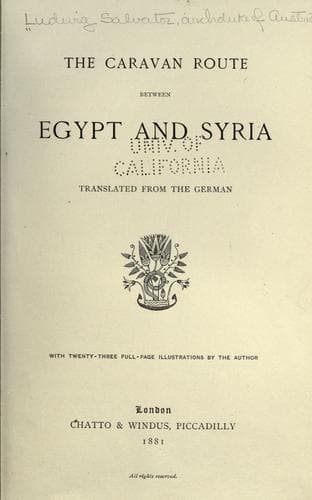
The Caravan Route between Egypt and SyriaLudwig Salvator, Archduke of Austria
History
The Caravan Route between Egypt and Syria
Ludwig Salvator, Archduke of Austria
Palestine -- Description and travel
The population numbers 2800 souls, exclusive of the Bedouins living in
the neighbourhood. With scarcely an exception, the people are
Mussulmans, and extremely fanatical; some portion of them are of Turkish
origin, but none speak Arabic. There are but eight Christians in the
place--three of whom are women. The garrison consists of sixty soldiers,
including ten artillery-men, commanded by the governor of the fortress,
whose especial task it is to restrain the excesses of the Bedouin
tribes. The latter have a great dread of the military, as immediately a
Sheik lays himself open to suspicion he is arrested and despatched to
Cairo. Their conduct has consequently of late been very circumspect,
particularly since their last outbreak, which was severely punished.
There are no rich people in Harish, the richest possessing at the most
not more than twenty camels; many persons are, on the contrary, so poor
as to be forced to procure their camels on credit. Should an animal
come to grief under such circumstances, the poor debtor is a ruined man.
Altogether there are 500 camels in the place--60 of which are for the
use of the soldiers; also 60 hayin or dromedaries, one only of which is
assigned to them. There is an almost incredible difference between the
capabilities of the camel and the dromedary, as much as between those of
the English draught-horse and race-horse. An idea of the extraordinary
fleetness of dromedaries may be gathered from the fact that there are
several in Harish who can run easily in one day from Harish to Kantara.
A very serviceable animal, suitable either for draught purposes or for
running, results from a cross between the dromedary and camel.
There are but ten horses in Harish; but, on the other hand, no less than
150 asses, of the black or black-and-white-spotted Bedouin race; about
200 goats, 100 sheep, and 35 cows. The sheep and cows are mostly from
Syria. Pigeons and fowls are largely kept, but only a few turkeys, and
still fewer ducks. Dogs are also not numerous.
The game of the district comprises quails (during the migratory season),
hares, and gazelles. The last named are caught by the Bedouins when
young, at some distance in the interior, but frequently die when their
horns begin to grow. They are transported long distances, without
injury, in a basket of palm leaves, the small feet being tucked up under
the belly, and the head only peering out of the basket, which of course
is firmly fastened with cord.
Public-domain text, read in full here on John Shaqi.
Reviews
Reviews
No reviews yet
Be the first to share your thoughts on this work.
Join the Discussion
Join the discussion
Sign in to leave a comment or review.
Sign InorCreate an account