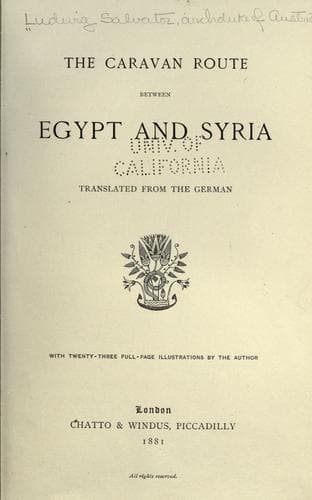
The Caravan Route between Egypt and SyriaLudwig Salvator, Archduke of Austria
History
The Caravan Route between Egypt and Syria
Ludwig Salvator, Archduke of Austria
Palestine -- Description and travel
Fish abound in the neighbouring sea, and are caught by moonlight, with a
bell-shaped net only, draw-nets being not used here. In Harish itself
there are not more than fifteen or twenty persons who follow fishery as
a calling. There are, however, many fishermen engaged in the preparation
of salt fish, who come over from Damietta and live behind the Berdovil.
In the same way they fish the Melleha, referred to above, in which are a
large number of mullet. The fishing-ground has been rented from the
Government by an Arab, who is even thinking of setting up a boat.
Hitherto the fishermen have always come here from Port Said, along the
shore, on foot.
The palm trees of Harish, of which there are about 6000, are the
principal basis of the local product. No impost whatever is paid for
them to the Government, the concession being presumably accorded to the
population, in consideration of their being inhabitants of a frontier
station. No wine is made from the palms of Harish, the sap being
principally used for the preparation of sugar. The black and red dates
are retained for home consumption, while the yellow, as also the Agua
dates (pounded date cakes), are exported in sacks. The fruit of the
place consists principally of figs and grapes, the latter being chiefly
grown in the western portion of the district. For the most part they are
white table grapes, but we heard that the under health officer of Harish
was attempting to make wine from some of them. Melons are also
extensively cultivated here, more particularly in Wadi, and are
preserved for some time by hanging. The vegetables include tomatoes,
garlic, onions, and carrots; barley, wheat, maize, and small sweet
vetches are also grown, more or less.
Industrial pursuits are almost entirely neglected. A few articles of
clothing, etc., are made for actual home use, but nothing more. These
comprise, for instance, winter jackets of sheepskins (made with the
bare skin outside, the hair being worn next the body); camel's-hair
sacks; close-fitting camel's-hair caps (a very warm and practical
head-gear, and consequently worn by the military and officials under
their fez); and black and striped cloaks of sheep's wool, such as are
seen in Syria.
Public-domain text, read in full here on John Shaqi.
Reviews
Reviews
No reviews yet
Be the first to share your thoughts on this work.
Join the Discussion
Join the discussion
Sign in to leave a comment or review.
Sign InorCreate an account