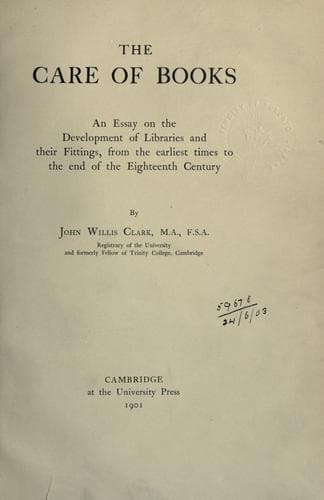
Libraries -- History; Library architecture -- History; Library fittings and supplies -- History
I am reminded of what I read years ago, hastily, as a
boy does, in the library of a man who was learned in
secular literature. There were there portraits of
Orators and also of Poets worked in mosaic, or in wax of
different colours, or in plaster, and under each the
master of the house had placed inscriptions noting their
characteristics; but, when he came to a poet of
acknowledged merit, as for instance, Virgil, he began as
follows:
Virgilium vatem melius sua carmina laudant;
In freta dum fluvii current, dum montibus umbrae
Lustrabunt convexa, polus dum sidera pascet,
Semper honos nomenque tuum laudesque manebunt.
Virgil's own lines most fitly Virgil praise:
As long as rivers run into the deep,
As long as shadows o'er the hillside sweep,
As long as stars in heaven's fair pastures graze,
So long shall live your honour, name, and praise.[108]
Agapetus, who was chosen Pope in 535, and lived for barely a year, had
intended, in conjunction with Cassiodorus, to found a college for teachers
of Christian doctrine. He selected for this purpose a house on the Caelian
Hill, afterwards occupied by S. Gregory, and by him turned into a
monastery. Agapetus had made some progress with the scheme, so far as the
library attached to the house was concerned, for the author of the
Einsiedlen MS., who visited Rome in the ninth century, saw the following
inscription "in the library of S. Gregory"--i.e. in the library attached
to the Church of San Gregorio Magno.
SANCTORVM VENERANDA COHORS SEDET ORDINE LONGO
DIVINAE LEGIS MYSTICA DICTA DOCENS
HOS INTER RESIDENS AGAPETVS IVRE SACERDOS
CODICIBVS PVLCHRVM CONDIDIT ARTE LOCVM
GRATIA PAR CVNCTIS SANCTVS LABOR OMNIBVS VNVS
DISSONA VERBA QVIDEM SED TAMEN VNA FIDES
Here sits in long array a reverend troop
Teaching the mystic truths of law divine:
'Mid these by right takes Agapetus place
Who built to guard his books this fair abode.
All toil alike, all equal grace enjoy--
Their words are different, but their faith the same.
These lines undoubtedly imply that there was on the walls a long series of
portraits of the Fathers of the Church, including that of Agapetus
himself, who had won his right to a place among them by building a
sumptuous home for their works[109].
Public-domain text, read in full here on John Shaqi.
Reviews
Reviews
No reviews yet
Be the first to share your thoughts on this work.
Join the Discussion
Join the discussion
Sign in to leave a comment or review.
Sign InorCreate an account