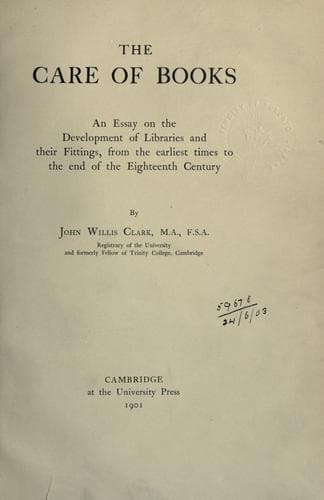
Libraries -- History; Library architecture -- History; Library fittings and supplies -- History
The design of Agapetus, interrupted by death, was carried forward by his
friend Cassiodorus, at a place in South Italy called Vivarium, near his
own native town Squillace. Shortly after his final retirement from court,
A.D. 538, Cassiodorus established there a brotherhood, which, for a time at
least, must have been a formidable rival to that of S. Benedict. A library
held a prominent place in his conception of what was needed for their
common life. He says little about its size or composition, but much
rhetoric is expended on the contrivances by which its usefulness and
attractiveness were to be increased. A staff of bookbinders was to clothe
the manuscripts in decorous attire; self-supplying lamps were to light
nocturnal workers; sundials by day, and water-clocks by night, enabled
them to regulate their hours. Here also was a _scriptorium_, and it
appears probable that between the exertions of Cassiodorus and his friend
Eugippius, South Italy was well supplied with manuscripts[110].
These attempts to snatch from oblivion libraries which, though probably
according to our ideas insignificant, were centres of culture in the
darkest of dark ages, will be illustrated by the fuller information that
has come down to us respecting the library of Isidore, Bishop of Seville
600-636. The "verses composed by himself for his own presses," to quote
the oldest manuscript containing them[111], have been preserved, with the
names of the writers under whose portraits they were inscribed.
There were fourteen presses, arranged as follows:
I. Origen.
II. Hilary.
III. Ambrose.
IV. Augustine.
V. Jerome.
VI. Chrysostom.
VII. Cyprian.
VIII. Prudentius.
IX. Avitus, Juvencus, Sedulius.
X. Eusebius, Orosius.
XI. Gregory.
XII. Leander.
XIII. Theodosius, Paulus, Gaius.
XIV. Cosmas, Damian, Hippocrates, Galen.
These writers are probably those whom Isidore specially admired, or had
some particular reason for commemorating. The first seven are obvious
types of theologians, and the presses over which they presided were
doubtless filled not merely with their own works, but with bibles,
commentaries, and works on Divinity in general. Eusebius and Orosius are
types of ecclesiastical historians; Theodosius, Paulus, and Gaius, of
jurists; Cosmas, Damian, etc. of physicians. But the Christian poets
Prudentius to Sedulius could hardly have needed two presses to contain
their works; nor Gregory the Great the whole of one. Lastly, Leander,
Isidore's elder brother, could only owe his place in the series to
fraternal affection. I conjecture that these portraits were simply
commemorative; and that the presses beneath them contained the books on
subjects not suggested by the rest of the portraits, as for example,
secular literature, in which Isidore was a proficient.
Public-domain text, read in full here on John Shaqi.
Reviews
Reviews
No reviews yet
Be the first to share your thoughts on this work.
Join the Discussion
Join the discussion
Sign in to leave a comment or review.
Sign InorCreate an account