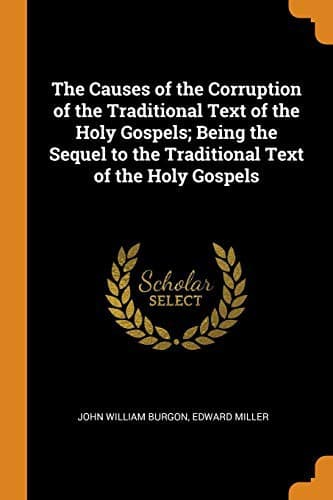
The Causes of the Corruption of the Traditional Text of the Holy Gospels: Being the Sequel to The Traditional Text of the Holy GospelsBurgon, John William
Religion
The Causes of the Corruption of the Traditional Text of the Holy Gospels: Being the Sequel to The Traditional Text of the Holy Gospels
Burgon, John William
Bible. Gospels -- Criticism, Textual
I must again remark with much emphasis that the foregoing suggestions
are offered to account for what may now be regarded as a fact, viz., the
connexion between the Western Text, as it is called, and Syriac remains
in regard to corruption in the text of the Gospels and of the Acts of
the Apostles. If that corruption arose at the very first spread of
Christianity, before the record of our Lord's Life had assumed permanent
shape in the Four Gospels, all is easy. Such corruption, inasmuch as it
beset the oral and written stories which were afterwards incorporated in
the Gospels, would creep into the authorized narrations, and would
vitiate them till it was ultimately cast out towards the end of the
fourth and in the succeeding centuries. Starting from the very
beginning, and gaining additions in the several ways described in this
volume by Dean Burgon, it would possess such vigour as to impress itself
on Low-Latin manuscripts and even on parts of the better Latin ones,
perhaps on Tatian's Diatessaron, on the Curetonian and Lewis manuscripts
of the fifth century, on the Codex Bezae of the sixth; also on the
Vatican and the Sinaitic of the fourth, on the Dublin Palimpsest of St.
Matthew of the sixth, on the Codex Regius or L of the eighth, on the St.
Gall MS. of the ninth in St. Mark, on the Codex Zacynthius of the eighth
in St. Luke, and a few others. We on our side admit that the corruption
is old even though the manuscripts enshrining it do not date very far
back, and cannot always prove their ancestry. And it is in this
admission that I venture to think there is an opening for a meeting of
opinions which have been hitherto opposed.
In the following treatise, the causes of corruption are divided into (I)
such as proceeded from Accident, and (II) those which were Intentional.
Under the former class we find (1) those which were involved in pure
Accident, or (2) in what is termed Homoeoteleuton where lines or
sentences ended with the same word or the same syllable, or (3) such as
arose in writing from Uncial letters, or (4) in the confusion of vowels
and diphthongs which is called Itacism, or (5) in Liturgical Influence.
The remaining instances may be conveniently classed as Intentional, not
because in all cases there was a settled determination to alter the
text, for such if any was often of the faintest character, but because
some sort of design was to a greater or less degree embedded in most of
them. Such causes were (1) Harmonistic Influence, (2) Assimilation, (3)
Attraction; such instances too in their main character were (4)
Omissions, (5) Transpositions, (6) Substitutions, (7) Additions, (8)
Glosses, (9) Corruption by Heretics, (10) Corruption by Orthodox.
Public-domain text, read in full here on John Shaqi.
Reviews
Reviews
No reviews yet
Be the first to share your thoughts on this work.
Join the Discussion
Join the discussion
Sign in to leave a comment or review.
Sign InorCreate an account