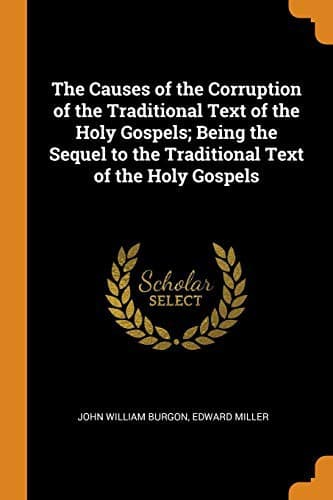
The Causes of the Corruption of the Traditional Text of the Holy Gospels: Being the Sequel to The Traditional Text of the Holy GospelsBurgon, John William
Religion
The Causes of the Corruption of the Traditional Text of the Holy Gospels: Being the Sequel to The Traditional Text of the Holy Gospels
Burgon, John William
Bible. Gospels -- Criticism, Textual
This dissection of the mass of corruption, or as perhaps it may be
better termed, this classification made by Dean Burgon of the numerous
causes which are found to have been at work from time to time, appears
to me to be most interesting to the inquirer into the hidden history of
the Text of the Gospels, because by revealing the influences which have
been at work it sheds light upon the entire controversy, and often
enables the student to see clearly how and why certain passages around
which dispute has gathered are really corrupt. Indeed, the vast and
mysterious ogre called corruption assumes shape and form under the acute
penetration and the deft handling of the Dean, whose great knowledge of
the subject and orderly treatment of puzzling details is still more
commended by his interesting style of writing. As far as has been
possible, I have let him in the sequel, except for such clerical
corrections as were required from time to time and have been much fewer
than his facile pen would have made, speak entirely for himself.
FOOTNOTES:
[1] It must be always borne in mind, that it is not enough for the
purpose of the other side to shew that the Traditional Text was in a
minority as regards attestation. They must prove that it was nowhere in
the earliest ages, if they are to establish their position that it was
made in the third and fourth centuries. Traditional Text of the Holy
Gospels, p. 95.
[2]
'A hydra in her direful shape,
With fifty darkling throats agape.'--
Altered from Conington's version, Aen. vi. 576.
[3]
'How oft soe'er the truth she tell,
What's false and wrong she loves too well.'--
Altered from Conington, Aen. iv. 188.
[4] Strabo, xvi, enumerates amongst its inhabitants Egyptians, Arabians,
and Phoenicians.
[5] Studia Biblica, i. 50-55. Dr. Neubauer, On the Dialects spoken in
Palestine in the time of Christ.
[6] Isaac Williams, On the Study of the Gospels, 341-352.
[7] My devoted Syrian friend, Miss Helanie Baroody, told me during her
stay in England that a village is pointed out as having been traversed
by our Lord on His way from Caesarea Philippi to Mount Hermon.
[8] It is hardly improbable that these two eminent Christians were some
of those whom St Paul found at Antioch when St. Barnabas brought him
there, and thus came to know intimately as fellow-workers ([Greek:
episemoi en tois apostolois, oi kai pro emou gegonasin en Christo]).
Most of the names in Rom. xvi are either Greek or Hebrew.
[9]
'Jam pridem Syrus in Tiberim defluxit Orontes
Et _linguam_ et mores ... vexit.'
--Juv. Sat. iii. 62-3.
CHAPTER I.
GENERAL CORRUPTION.
Sec. 1.
Public-domain text, read in full here on John Shaqi.
Reviews
Reviews
No reviews yet
Be the first to share your thoughts on this work.
Join the Discussion
Join the discussion
Sign in to leave a comment or review.
Sign InorCreate an account