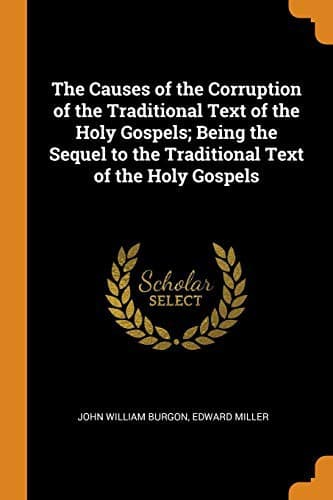
The Causes of the Corruption of the Traditional Text of the Holy Gospels: Being the Sequel to The Traditional Text of the Holy GospelsBurgon, John William
Religion
The Causes of the Corruption of the Traditional Text of the Holy Gospels: Being the Sequel to The Traditional Text of the Holy Gospels
Burgon, John William
Bible. Gospels -- Criticism, Textual
[16] I am inclined to believe that in the age immediately succeeding
that of the Apostles, some person or persons of great influence and
authority executed a Revision of the N.T. and gave the world the result
of such labours in a 'corrected Text.' The guiding principle seems to
have been to seek to _abridge_ the Text, to lop off whatever seemed
redundant, or which might in any way be spared, and to eliminate from
one Gospel whatever expressions occurred elsewhere in another Gospel.
Clauses which slightly obscured the speaker's meaning; or which seemed
to hang loose at the end of a sentence; or which introduced a
consideration of difficulty:--words which interfered with the easy flow
of a sentence:--every thing of this kind such a personage seems to have
held himself free to discard. But what is more serious, passages which
occasioned some difficulty, as the _pericope de adultera_; physical
perplexity, as the troubling of the water; spiritual revulsion, as the
agony in the garden:--all these the reviser or revisers seem to have
judged it safest simply to eliminate. It is difficult to understand how
any persons in their senses could have so acted by the sacred deposit;
but it does not seem improbable that at some very remote period there
were found some who did act in some such way. Let it be observed,
however, that unlike some critics I do not base my real argument upon
what appears to me to be a not unlikely supposition.
[17] [Unless it be referred to the two converging streams of corruption,
as described in The Traditional Text.]
CHAPTER II.
ACCIDENTAL CAUSES OF CORRUPTION.
I. Pure Accident.
[It often happens that more causes than one are combined in the origin
of the corruption in any one passage. In the following history of a
blunder and of the fatal consequences that ensued upon it, only the
first step was accidental. But much instruction may be derived from the
initial blunder, and though the later stages in the history come under
another head, they nevertheless illustrate the effects of early
accident, besides throwing light upon parts of the discussion which are
yet to come.]
Sec. 1.
We are sometimes able to trace the origin and progress of accidental
depravations of the text: and the study is as instructive as it is
interesting. Let me invite attention to what is found in St. John x. 29;
where,--instead of, 'My Father, who hath given them [viz. My sheep] to
Me, is greater than all,'--Tischendorf, Tregelles, Alford, are for
reading, 'That thing which My (_or_ the) Father hath given to Me is
greater (i.e. is a greater thing) than all.' A vastly different
proposition, truly; and, whatever it may mean, wholly inadmissible here,
as the context proves. It has been the result of sheer accident
moreover,--as I proceed to explain.
Public-domain text, read in full here on John Shaqi.
Reviews
Reviews
No reviews yet
Be the first to share your thoughts on this work.
Join the Discussion
Join the discussion
Sign in to leave a comment or review.
Sign InorCreate an account