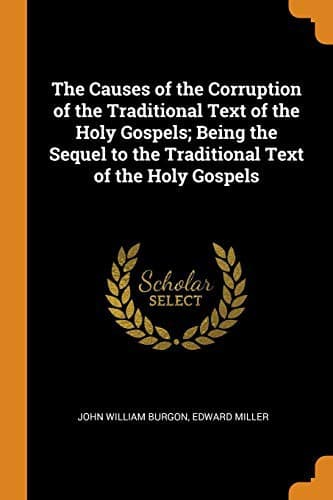
The Causes of the Corruption of the Traditional Text of the Holy Gospels: Being the Sequel to The Traditional Text of the Holy GospelsBurgon, John William
Religion
The Causes of the Corruption of the Traditional Text of the Holy Gospels: Being the Sequel to The Traditional Text of the Holy Gospels
Burgon, John William
Bible. Gospels -- Criticism, Textual
St. John certainly wrote the familiar words,--[Greek: ho pater mou]
[Greek: os dedoke moi, meizon panton esti]. But, with the licentiousness
[or inaccuracy] which prevailed in the earliest age, some remote copyist
is found to have substituted for [Greek: hos dedoke], its grammatical
equivalent [Greek: ho dedokos]. And this proved fatal; for it was only
necessary that another scribe should substitute [Greek: meizon] for
[Greek: meizon] (after the example of such places as St. Matt. xii. 6,
41, 42, &c.), and thus the door had been opened to at least four
distinct deflections from the evangelical verity,--which straightway
found their way into manuscripts:--(1) [Greek: o dedokos ... meizon]--of
which reading at this day D is the sole representative: (2) [Greek: os
dedoke ... meizon]--which survives only in AX: (3) [Greek: o dedoke ...
meizon]--which is only found in [Symbol: Aleph]L: (4) [Greek: o dedoke
... meizon]--which is the peculiar property of B. The 1st and 2nd of
these sufficiently represent the Evangelist's meaning, though neither of
them is what he actually wrote; but the 3rd is untranslatable: while the
4th is nothing else but a desperate attempt to force a meaning into the
3rd, by writing [Greek: meizon] for [Greek: meizon]; treating [Greek: o]
not as the article but as the neuter of the relative [Greek: os].
This last exhibition of the text, which in fact scarcely yields an
intelligible meaning and rests upon the minimum of manuscript evidence,
would long since have been forgotten, but that, calamitously for the
Western Church, its Version of the New Testament Scriptures was executed
from MSS. of the same vicious type as Cod. B[18]. Accordingly, all the
Latin copies, and therefore all the Latin Fathers[19], translate,--
'Pater [meus] quod dedit mihi, majus omnibus est[20].' The Westerns
resolutely extracted a meaning from whatever they presumed to be genuine
Scripture: and one can but admire the piety which insists on finding
sound Divinity in what proves after all to be nothing else but a sorry
blunder. What, asks Augustine, was 'the thing, greater than all,' which
the Father gave to the Son? To be the Word of the Father (he answers),
His only-begotten Son and the brightness of His glory[21]. The Greeks
knew better. Basil[22], Chrysostom[23], Cyril on nine occasions[24],
Theodoret[25]--as many as quote the place--invariably exhibit the
_textus receptus_ [Greek: os ... meizon], which is obviously the true
reading and may on no account suffer molestation.
Public-domain text, read in full here on John Shaqi.
Reviews
Reviews
No reviews yet
Be the first to share your thoughts on this work.
Join the Discussion
Join the discussion
Sign in to leave a comment or review.
Sign InorCreate an account