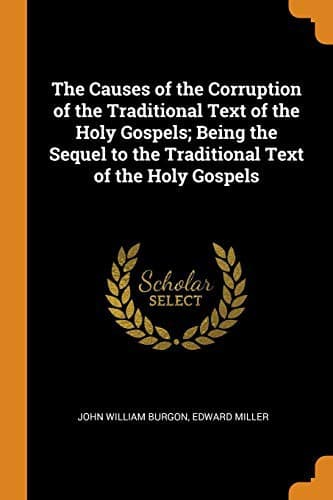
The Causes of the Corruption of the Traditional Text of the Holy Gospels: Being the Sequel to The Traditional Text of the Holy GospelsBurgon, John William
Religion
The Causes of the Corruption of the Traditional Text of the Holy Gospels: Being the Sequel to The Traditional Text of the Holy Gospels
Burgon, John William
Bible. Gospels -- Criticism, Textual
Strange to say it results in the following monstrous figment:--that the
fruit of Herod's incestuous connexion with Herodias had been a daughter,
who was also named Herodias; and that she,--the King's own
daughter,--was the immodest one[48] who came in and danced before him,
'his lords, high captains, and chief estates of Galilee,' as they sat at
the birthday banquet. Probability, natural feeling, the obvious
requirements of the narrative, History itself--, for Josephus expressly
informs us that 'Salome,' not 'Herodias,' was the name of Herodias'
daughter[49],--all reclaim loudly against such a perversion of the
truth. But what ought to be in itself conclusive, what in fact settles
the question, is the testimony of the MSS.,--of which only seven
([Symbol: Aleph]BDL[Symbol: Delta] with two cursive copies) can be found
to exhibit this strange mistake. Accordingly the reading [Greek: AUTOU]
is rejected by Griesbach, Lachmann, Tregelles, Tischendorf and Alford.
It has nevertheless found favour with Dr. Hort; and it has even been
thrust into the margin of the revised Text of our Authorized Version, as
a reading having some probability.
This is indeed an instructive instance of the effect of accidental
errors--another proof that [Symbol: Aleph]BDL cannot be trusted.
Sufficiently obvious are the steps whereby the present erroneous reading
was brought to perfection. The immediate proximity in MSS. of the
selfsame combination of letters is observed invariably to result in a
various reading. [Greek: AUTESTES] was safe to part with its second
[Greek: TES] on the first opportunity, and the definitive article
([Greek: tes]) once lost, the substitution of [Greek: AUTOU] for [Greek:
AUTES] is just such a mistake as a copyist with ill-directed
intelligence would be sure to fall into if he were bestowing sufficient
attention on the subject to be aware that the person spoken of in verses
20 and 21 is Herod the King.
[This recurrence of identical or similar syllables near together was a
frequent source of error. Copying has always a tendency to become
mechanical: and when the mind of the copyist sank to sleep in his
monotonous toil, as well as if it became too active, the sacred Text
suffered more or less, and so even a trifling mistake might be the seed
of serious depravation.]
Sec. 5.
Another interesting and instructive instance of error originating in
sheer accident, is supplied by the reading in certain MSS. of St. Mark
viii. 1. That the Evangelist wrote [Greek: pampollou ochlou] 'the
multitude being very great,' is certain. This is the reading of all the
uncials but eight, of all the cursives but fifteen. But instead of this,
it has been proposed that we should read, 'when there was again a great
multitude,' the plain fact being that some ancient scribe mistook, as he
easily might, the less usual compound word for what was to himself a far
more familiar expression: i.e. he mistook [Greek: PAMPOLLOU] for [Greek:
PALIN POLLOU].
Public-domain text, read in full here on John Shaqi.
Reviews
Reviews
No reviews yet
Be the first to share your thoughts on this work.
Join the Discussion
Join the discussion
Sign in to leave a comment or review.
Sign InorCreate an account