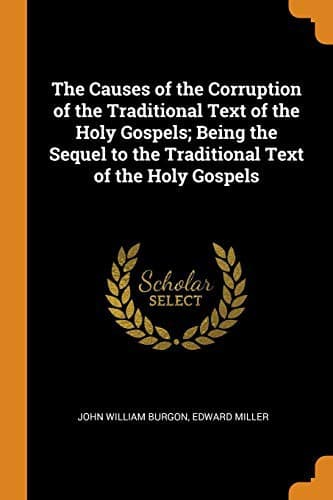
The Causes of the Corruption of the Traditional Text of the Holy Gospels: Being the Sequel to The Traditional Text of the Holy GospelsBurgon, John William
Religion
The Causes of the Corruption of the Traditional Text of the Holy Gospels: Being the Sequel to The Traditional Text of the Holy Gospels
Burgon, John William
Bible. Gospels -- Criticism, Textual
This blunder must date from the second century, for 'iterum' is met with
in the Old Latin as well as in the Vulgate, the Gothic, the Bohairic,
and some other versions. On the other hand, it is against 'every true
principle of Textual Criticism' (as Dr. Tregelles would say), that the
more difficult expression should be abandoned for the easier, when
forty-nine out of every fifty MSS. are observed to uphold it; when the
oldest version of all, the Syriac, is on the same side; when the source
of the mistake is patent; and when the rarer word is observed to be in
St. Mark's peculiar manner. There could be in fact no hesitation on this
subject, if the opposition had not been headed by those notorious false
witnesses [Symbol: Aleph]BDL, which it is just now the fashion to uphold
at all hazards. They happen to be supported on this occasion by
GMN[Symbol: Delta] and fifteen cursives: while two other cursives look
both ways and exhibit [Greek: palin pampollou].
In St Mark vii. 14, [Greek: palin] was similarly misread by some
copyists for [Greek: panta], and has been preserved by [Symbol:
Aleph]BDL[Symbol: Delta] ([Greek: PALIN] for [Greek: PANTA]) against
thirteen uncials, all the cursives, the Peshitto and Armenian.
So again in St. John xiii. 37. A reads [Greek: dynasai moi] by an
evident slip of the pen for [Greek: dynamai soi]. And in xix. 31 [Greek:
megalE E Emera] has become [Greek: megale hemera] in [Symbol:
Aleph]AE[Symbol: Gamma] and some cursive copies.
FOOTNOTES:
[18] See the passages quoted in Scrivener's Introduction, II. 270-2, 4th
ed.
[19] Tertull. (Prax. c. 22): Ambr. (ii. 576, 607, 689 _bis_): Hilary
(930 _bis_, 1089): Jerome (v. 208): Augustin (iii^2. 615): Maximinus, an
Arian bishop (_ap_. Aug. viii. 651).
[20] Pater (_or_ Pater meus) quod dedit mihi (_or_ mihi dedit), majus
omnibus est (_or_ majus est omnibus: _or_ omnibus majus est).
[21] iii^2. 615. He begins, '_Quid dedit Filio Pater majus omnibus? Ut
ipsi ille esset unigenitus Filius_.'
[22] i. 236.
[23] viii. 363 _bis_.
[24] i. 188: ii. 567: iii. 792: iv. 666 (ed. Pusey): v^1. 326, 577, 578:
_ap._ Mai ii. 13: iii. 336.
[25] v. 1065 (=Dial^{Maced} _ap._ Athanas. ii. 555).
[26] Viz. + [Greek: mou] ABD:--[Greek: mou] [Symbol: Aleph] | [Greek:
os] A: [Greek: o] B[Symbol: Aleph]D | [Greek: dedoken] B[Symbol:
Aleph]A: [Greek: dedokos] | [Greek: meizon] [Symbol: Aleph]D: [Greek:
meizon] AB | [Greek: meiz. panton estin] A: [Greek: panton meiz. estin]
B[Symbol: Aleph]D.
[27] The Revision Revised, p. 51-3.
[28] The Revision Revised, p. 53-4.
[29] Ibid. p. 51-6.
[30] Ibid. p. 177-8.
[31] Also in Ammonius the presbyter, A.D. 458--see Cramer's Cat. p.
334-5, _last line_. [Greek: Logou] is read besides in the cursives Act.
36, 96, 105.
Public-domain text, read in full here on John Shaqi.
Reviews
Reviews
No reviews yet
Be the first to share your thoughts on this work.
Join the Discussion
Join the discussion
Sign in to leave a comment or review.
Sign InorCreate an account