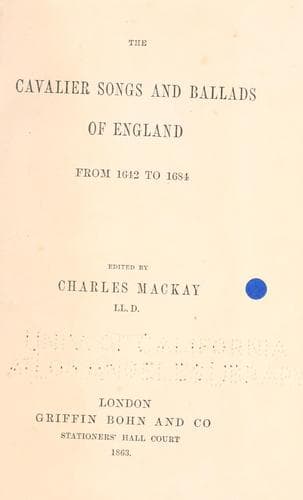
The Cavalier Songs and Ballads of England from 1642 to 1684
History
The Cavalier Songs and Ballads of England from 1642 to 1684
Ballads, English; English poetry -- Early modern, 1500-1700
Transcribed from the 1863 Griffin Bohn and Co. edition by David Price,
email ccx074@pglaf.org
The
CAVALIER SONGS AND BALLADS
OF ENGLAND
FROM 1642 TO 1684
* * * * *
EDITED BY
CHARLES MACKAY
LL.D.
* * * * *
LONDON
GRIFFIN BOHN AND CO
STATIONERS’ HALL COURT
1863.
* * * * *
JOHN CHILDS AND SON, PRINTERS.
* * * * *
INTRODUCTION.
THE Cavalier Ballads of England, like the Jacobite Ballads of England and
Scotland at a later period, are mines of wealth for the student of the
history and social manners of our ancestors. The rude but often
beautiful political lyrics of the early days of the Stuarts were far more
interesting and important to the people who heard or repeated them, than
any similar compositions can be in our time. When the printing press was
the mere vehicle of polemics for the educated minority, and when the
daily journal was neither a luxury of the poor, a necessity of the rich,
nor an appreciable power in the formation and guidance of public opinion,
the song and the ballad appealed to the passion, if not to the intellect
of the masses, and instructed them in all the leading events of the time.
In our day the people need no information of the kind, for they procure
it from the more readily available and more copious if not more reliable,
source of the daily and weekly press. The song and ballad have ceased to
deal with public affairs. No new ones of the kind are made except as
miserable parodies and burlesques that may amuse sober costermongers and
half-drunken men about town, who frequent music saloons at midnight, but
which are offensive to every one else. Such genuine old ballads as
remain in the popular memory are either fast dying out, or relate
exclusively to the never-to-be-superseded topics of love, war, and wine.
The people of our day have little heart or appreciation for song, except
in Scotland and Ireland. England and America are too prosaic and too
busy, and the masses, notwithstanding all their supposed advantages in
education, are much too vulgar to delight in either song or ballad that
rises to the dignity of poetry. They appreciate the buffooneries of the
“Negro Minstrelsy,” and the inanities and the vapidities of sentimental
love songs, but the elegance of such writers as Thomas Moore, and the
force of such vigorous thinkers and tender lyrists as Robert Burns, are
above their sphere, and are left to scholars in their closets and ladies
in their drawing-rooms. The case was different among our ancestors in
Public-domain text, read in full here on John Shaqi.
Reviews
Reviews
No reviews yet
Be the first to share your thoughts on this work.
Join the Discussion
Join the discussion
Sign in to leave a comment or review.
Sign InorCreate an account