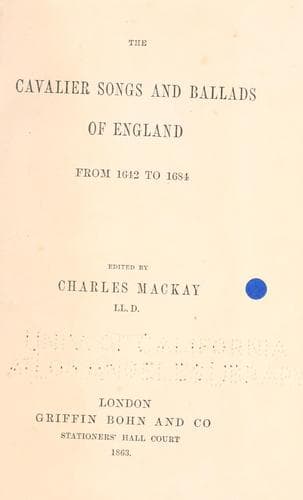
The Cavalier Songs and Ballads of England from 1642 to 1684
History
The Cavalier Songs and Ballads of England from 1642 to 1684
Ballads, English; English poetry -- Early modern, 1500-1700
{64} James Harrington, a remarkable political writer of this time, had
founded a club called the Rota, in 1659, for the debating of political
questions. This club met at Miles’s Coffee-house, in Old Palace Yard,
and lasted a few mouths. At the beginning of the present year was
published the result of their deliberations, under the title of “The
Rota: or, a Model of a Free State, or Equall Commonwealth; once proposed
and debated in brief, and to be again more at large proposed to, and
debated by, a free and open Society of ingenious Gentlemen.” 4to,
London, 1660 (Jan. 9).
{65} William Prynne, the lawyer, who had been so active a member of the
Long Parliament when the Presbyterians were in power, was one of the
secluded members. He returned to the House on the 21st of January, this
year. Pepys says, “Mr Prin came with an old basket-hilt sword on, and
had a great many shouts upon his going into the hall.”
{66} John Wilde was one of the members for Worcestershire in the Long
Parliament. In Cromwell’s last Parliament he represented Droitwich, and
was made by the Protector “Lord Chief Baron of the publick Exchequer.”
In a satirical pamphlet, contemporary with the present ballad, he is
spoken of as “Sarjeant Wilde, best known by the name of the Wilde
Serjeant.” Another old song describes his personal appearance:
“But, Baron Wild, come out here,
Show your ferret face and snout here,
For you, being both a fool and a knave,
Are a monster in the rout here.”
Loyal songs II. 55.
{67} See footnote {60}.
{68} Alderman Atkins.
{69} Ludlow was well known as a staunch Republican. The incident
alluded to was a subject of much merriment, and exercised the pen of some
of the choicest poets of the latter half of the seventeenth century.—T.
W.
{70} Lambert, with his army, was in the North, and amid the
contradictory intelligence which daily came in, we find some people who,
according to Pepys, spread reports that Lambert was gaining strength.—T.
W.
{71} Marchamont Nedham.
{72} Lambert and “his bears” are frequently mentioned in the satirical
writings of this period. Cromwell is said to have sworn “by the living
God,” when he dissolved the Long Parliament.—T. W.
{73} Speaker of the Long Parliament.
{74} Harry Marten, member for Berkshire, a man of equivocal private
character. In the heat of the civil wars he had been committed to the
Tower for a short time by the Parliament, for speaking too openly against
the person of the King. When he attempted to speak against the violent
dissolution of the Long Parliament by Cromwell, the latter reproached him
with the licentiousness of his life.—T. W.
Public-domain text, read in full here on John Shaqi.
Reviews
Reviews
No reviews yet
Be the first to share your thoughts on this work.
Elsewhere in the archive
Join the Discussion
Join the discussion
Sign in to leave a comment or review.
Sign InorCreate an account