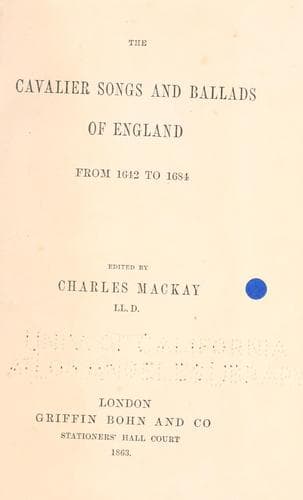
The Cavalier Songs and Ballads of England from 1642 to 1684
History
The Cavalier Songs and Ballads of England from 1642 to 1684
Ballads, English; English poetry -- Early modern, 1500-1700
{75} William Lord Monson, Viscount Castlemaine, was member for Ryegate.
He was degraded from his honours at the Restoration, and was condemned to
be drawn on a sledge with a rope round his neck from the Tower to Tyburn,
and back again, and to be imprisoned there for life. It appears, by the
satirical tracts of the day, that he was chiefly famous for being beaten
by his wife.—T. W.
{76} Sir Arthur Haselrigge, member for Leicestershire.
{77} Noise or disturbance.
{78} Dr John Hewit, an episcopal clergyman, executed for high treason in
1658, for having held an active correspondence with the Royalists abroad,
and having zealously contributed to the insurrection headed by
Penruddock.
{79} John Lowry, member for Cambridge.
{80} Sir Edmund Prideaux, Bart., member for Lyme Regis. He was
Cromwell’s Attorney-General.
{81} Oliver St John, member for Totness, and Lord Chief Justice of the
Common Pleas.
{82} John Wilde, one of the members for Worcestershire. In Cromwell’s
last Parliament he represented Droitwich, and was made by the Protector
“Lord Chief Baron of the Public Exchequer.”
{83} Sir Henry Slingsby and Dr Hewet were executed for treason against
the government of Oliver Cromwell in 1658. Colonel John Gerard was
brought to the block at the beginning of the Protectorate, in 1654, for
being engaged in a plot to assassinate Cromwell.
{84} John Lord Lisle represented Yarmouth in the Long Parliament. He
sat for Kent in the Parliament of 1653, and was afterwards a member of
Cromwell’s “other House,” and held the office of Lord Commissioner of the
Great Seal. He was president of the High Courts of Justice which tried
Gerard, Slingsby, and Hewet.
{85} Nathaniel Fiennes, member for Banbury. In the Parliament of 1654
he represented Oxfordshire. He was afterwards, as Nathaniel Lord
Fiennes, a member of Cromwell’s “other House.” Fiennes was accused of
cowardice in surrendering Bristol (of which he was governor) to Prince
Rupert, somewhat hastily, in 1643. His father, Lord Say and Sele,
opposing Cromwell, was obliged to retire to the Isle of Lundy.
{86} John Lord Glynn, member of Cromwell’s “other House,” was “Chief
Justice assigned to hold pleas in the Upper Bench.” He was engaged in
the prosecution of the Earl of Strafford. He was one of the eleven
members impeached by the army in 1647. In the Long Parliament, as well
as in Cromwell’s Parliaments, he was member for Carnarvon.—T. W.
{87} Henry Nevil, member for Abingdon. In Cromwell’s last Parliament he
represented Reading. In a satirical tract, he is spoken of as “religious
Harry Nevill;” and we find in Burton’s Diary, that some months before the
date of the present song (on the 16th Feb. 1658–9) there was “a great
debate” on a charge of atheism and blasphemy which had been brought
against him.—T. W.
Public-domain text, read in full here on John Shaqi.
Reviews
Reviews
No reviews yet
Be the first to share your thoughts on this work.
Elsewhere in the archive
Join the Discussion
Join the discussion
Sign in to leave a comment or review.
Sign InorCreate an account