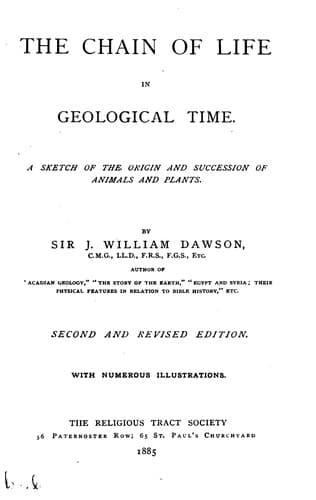
The Chain of Life in Geological Time: A Sketch of the Origin and Succession of Animals and PlantsDawson, John William, Sir
Science
The Chain of Life in Geological Time: A Sketch of the Origin and Succession of Animals and Plants
Dawson, John William, Sir
Paleobotany; Paleontology
As to the first of these questions, it is certain that, up to this time,
the origination of the living being from the non-living is an
inscrutable mystery. No one has witnessed this change, or has been able
to effect it experimentally. Nor have we any direct evidence of the
origination of one specific type from another. Such reasonings as assume
the possibility of these things, or on analogical grounds assert their
probability, belong rather to the domain of philosophical speculation
than to science. As to the laws of the succession of life, however, it
is possible to learn something from the sequence of facts as already
ascertained; and though much remains to be discovered, there are a few
leading statements on this subject which can already be made with
safety.
Unity and uniformity, within the limits imposed by progress and
increasing complexity, can be affirmed of the whole process. From the
dawn of life to the present time the great laws of physical nature which
operate on animals and plants have been uniform. These stable laws have
regulated the action of the outer world on organisms. The plans of
structure of these organisms laid down at the first have been followed
throughout. Thus the succession of life presents nothing fortuitous or
arbitrary, but a continuous plan carried out uniformly in time and
space, with certain materials of fixed properties, and with certain
structures predetermined from the first. There is, for example, a great
sameness of plan throughout the whole history of the marine invertebrate
life of the Palæozoic. If we turn over the pages of an illustrated
text-book of geology, or examine the cases or drawers of a collection of
fossils, we shall find extending through every succeeding formation,
representative forms of Crustaceans, Mollusks, and Corals, in such a
manner as to indicate that in each successive period there has been a
reproduction of the same type with modifications; and if the series is
not continuous, this appears to be due to lack of specimens, or to
abrupt physical changes; since sometimes, where two formations pass into
each other, we find a gradual change in the fossils by the dropping out
and introduction of species one by one. Thus in the whole of the great
Palæozoic period, both in its fauna and flora, we have a continuity and
similarity of a most marked character.
There is, indeed, nothing to preclude the supposition that many forms
reckoned as species are really only race modifications. My own
provisional conclusion, based on the study of Palæozoic plants,
published many years ago,[93] is that the general law will be found to
be the existence of distinct specific types independent of each other,
but liable in geological time to minor modifications, which have often
been regarded as distinct species.
Public-domain text, read in full here on John Shaqi.
Reviews
Reviews
No reviews yet
Be the first to share your thoughts on this work.
Elsewhere in the archive
Join the Discussion
Join the discussion
Sign in to leave a comment or review.
Sign InorCreate an account