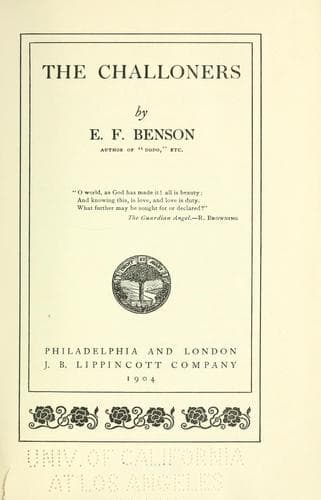
Clergy -- England -- Fiction; England -- Social life and customs -- Fiction; Families -- England -- Fiction
There was no doubt whatever that Martin’s piano-playing was of a very
remarkable order, and before he was half-way through Chopin’s first
_ballade_, Stella, who had been accustomed to consider the piano as an
instrument for the encouragement of conversation after dinner, or at the
most as the introduction to the vocal part of a concert, found herself
sitting bolt upright in her chair with a strange tingling excitement
spreading through her and a heightened and quickened beating of the
blood. She was essentially unmusical; but something in this was
extraordinarily arresting; her nerves, if not her sense of melody, were
at attention. As for Lady Sunningdale, she always gasped when Martin
played, and did so now.
“Too heavenly,” she said at the end. “Now make me miserable. Play the
rain on the roof. Tum, tum, tum, tum, don’t you know. Yes, how clever of
you to guess.”
It was rather clever, for Lady Sunningdale’s rendering did not really
resemble any one tune in the world more than any other.
Martin paused a moment. Then the slow, sullen drip of hot, steady rain
on the roof began, as it sounded to a man who was alone in an alien
land. It fell with hopeless regular iteration from grey skies, then
there was the gurgle of some choked gutter, and the collected water
overflowed and was spilt with a little chuckle. Very distantly on the
horizon remote lightning winked and flickered, but there was as yet no
sound of thunder in the dark sultriness of the afternoon, but only the
endless, monotonous rhythm of the dropping rain. Then, faintly at first
but with slow crescendo, there was heard the distant drums of thunder,
buffeting and rumbling among the hills. Then all at once the rain grew
heavier; larger drops, as if of lead, fell beating with a resonant
insistance on the roof, and the voice of the storm grew angry and
articulate. Suddenly with an appalling crash it burst immediately
overhead, drowning for a moment the beat of the rain, and by the blaze
of the simultaneous flash sea, sky, and the wave-beaten rocks of Majorca
leapt into light. Then, as thunder will, it drew away, and for a time
the rain was not so heavy, but again the storm swept up, and once more
the chariots of God crashed on their way above them, and the wild
lantern of the storm flared this way and that, and once more again after
that stupendous riot in the skies the hot darkness was punctuated by the
dreadful melancholy of the dripping rain. Then the storm growled itself
away into the distance; a little light came back into the weeping skies;
the pulse of the rain grew fainter, and again a choked gutter gurgled
and overflowed. Suddenly, through some unconjectured rift in the clouds,
one beam of the sun, divinely clear, shot down for a moment on them with
excellent brightness. Yet it was only for a moment; again the clouds
drifted up, and the rain, which for that minute had ceased, began again,
dripping with hopeless regular iteration on to the roof as evening
Public-domain text, read in full here on John Shaqi.
Reviews
Reviews
No reviews yet
Be the first to share your thoughts on this work.
Join the Discussion
Join the discussion
Sign in to leave a comment or review.
Sign InorCreate an account