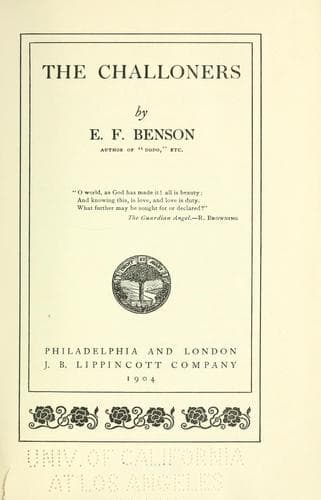
Clergy -- England -- Fiction; England -- Social life and customs -- Fiction; Families -- England -- Fiction
Now, though to have a very strong vocation towards a particular work, to
be convinced that such work is the highest and best in the world, and to
do it is a disposition of affairs that makes for happiness, it is
probable that if you had taken Mr. Challoner unawares and asked him if
he was happy, he would have hesitated before he answered. For, in spite
of his firm and convinced attitude, both towards life in general and to
those most intimate with him, there rose deep down in the man a great
fountain of tenderness, a great longing for love. Herein lay the secret
tragedy of his life: he longed with the same intensity with which he
served God for the ordinary human affections and relationships, but
through the armour-crust of his nature--an armour, be it noted, of
welded and hammered work and duty--his human hand could not break its
way to clasp the hands of others. That still was the tragedy of his life
with regard to his two children, just as it had been even more bitterly
so with regard to his wife, a half-Italian by birth, whom he had adored
with that serious fervour which suffused his nature. It was just his
spiritual anxiety and care for her which had, by a refined irony of
fate, come like an impassible barrier between them. To her he seemed
always to be checking the innocent and sunny impulses of joy that were
as vitally hers as fervour was his. He put it that there was always
something better to be done with the precious passing hours than to sing
or laugh or gather flowers or embroider some dainty fragment of personal
embellishment. Or, rather, let her take these innocent tastes and raise
them, elevate them, dedicate them. Let her sing by all means, but let
her gift of music be devoted to the help of the parish choir; let her
gather flowers to send to the sick; let her embroider an altar-cloth.
But poor Mrs. Challoner, a girl still in years, whose motor-power in
life was joy, found that to fit her pleasures to useful ends meant that
they ceased to be pleasures. There are many natures, not necessarily
shallow or selfish, like that; and when her husband told her that the
flowers with which she loved to fill her rooms were beautiful to her so
that thereby her thoughts might be led heavenwards, she was minded to
throw them away.
Public-domain text, read in full here on John Shaqi.
Reviews
Reviews
No reviews yet
Be the first to share your thoughts on this work.
Join the Discussion
Join the discussion
Sign in to leave a comment or review.
Sign InorCreate an account