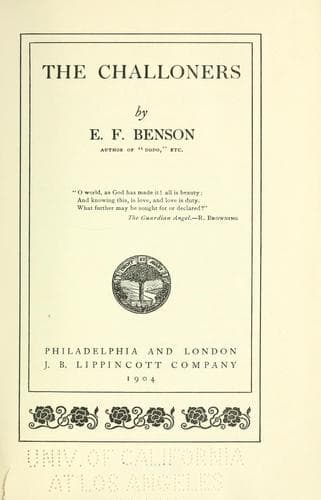
Clergy -- England -- Fiction; England -- Social life and customs -- Fiction; Families -- England -- Fiction
From the first, indeed, the marriage had been strangely ill-assorted. It
may have been made in heaven, but in that case it would probably have
been far better if it had not come down to earth. Sidney Challoner had
had his reason and his senses taken captive for a time by this delicious
piece of dew and sunlight; on her side his imperiousness, his eager
over-mastering desire for her, his extreme good looks, and perhaps also
the fact that he stood next in succession to the earldom of Flintshire,
his elder brother, the present holder of that delightful position, being
unmarried, led her to accept his devotion. This disillusionment had soon
come to each. The exquisite child-like beauty of his wife, behind which
he had conjectured the child-like spirit, he found to be a mere mask;
while to her the fiery, dominating lover turned to a hard, unbending
master. A year after their marriage twins were born, and from that time
the girl-mother had drooped and dwindled. The fogs of this northern
climate--fogs, too, more intimate and distressing of mind and
spirit--and the absence of mirth and laughter chilled her to the bone,
and a year afterwards she was dead.
Her death left him inconsolable, in so far that he determined never to
marry again; but when his sister Clara came to keep house for him and
look after the early education of Martin and Helen, it cannot be denied
that the widower found himself more comfortable than he had been. For
Clara was one of those not uncommon English spinsters who had a perfect
passion for doing the things she ought to do and leaving completely
undone the things she ought not. As the feminine element in the house of
a parish priest it was her clear mission to be aunt, if not mother, to
the flock, and classes and instructions, so hated of her niece’s soul,
grew up under her care like seed sown in April. She had practically no
pleasures, and her only relaxation was Patience, which she played
regularly from the time dinner was finished till family prayers at a
quarter to ten. Precisely at twenty minutes to ten, if the cards were
going awkwardly, she began to cheat, and continued, if necessary, to
cheat until the parlourmaid began to set out a row of chairs for the
servants. Thus she was able by the time they filed in to sweep the cards
triumphantly up together in their due and proper order and be humbly
thankful for the temptations into which she had not fallen that day.
Public-domain text, read in full here on John Shaqi.
Reviews
Reviews
No reviews yet
Be the first to share your thoughts on this work.
Join the Discussion
Join the discussion
Sign in to leave a comment or review.
Sign InorCreate an account