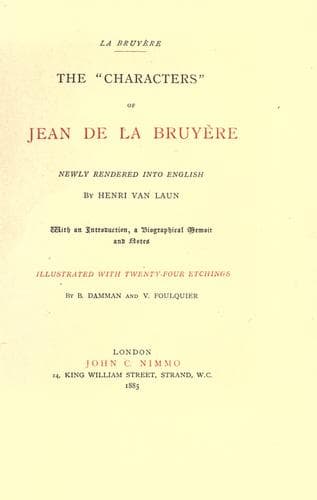
The "Characters" of Jean de La BruyèreLa Bruyère, Jean de
General
The "Characters" of Jean de La Bruyère
La Bruyère, Jean de
Character sketches -- Early works to 1800; Characters and characteristics
(27.) At a first and single glance we ought not to judge of men as
of a picture or statue; there is an inner man, and a heart to be
searched; a veil of modesty covers merit, and a mask of hypocrisy
covers wickedness. Few there are whose discernment authorises them to
decide; it is but gradually, and even then, perhaps, compelled by time
and circumstances, that perfect virtue or absolute vice show themselves
in their true colours.
(28.) A FRAGMENT.... “He said that the intelligence of this fair lady
was like a diamond in a handsome setting,” and, continuing to speak
of her, he added: “Her common sense and agreeable manners charm the
eyes and hearts of all who converse with her, so that they do not know
whether to love or to admire her most; she can be a perfect friend,
or produce such an impression that her admirers feel inclined to
transgress the bounds of friendship. Too young and healthy-looking not
to please, but too modest to affect it, she esteems men only for their
merit, and believes she has only friends; her vivacity and sentiment
surprise and interest us, and though she knows perfectly the delicacies
and niceties of conversation, she sometimes suddenly makes some happy
observations, which give a great deal of pleasure and need not be
answered. She speaks to you like one who is not learned, who is not
certain of anything, and wants to be informed; and she listens to you
as a person who knows a great deal, highly values what you say, and
on whom nothing of what you say is lost. Far from pretending to be
witty by contradicting you, and by imitating Elvira, who had rather
be thought sprightly than a woman of sense and sound judgment, she
adopts your thoughts, thinks they are her own, enlarges on them, and
embellishes them; and makes you pleased you have thought so correctly
and expressed yourself better than you believed you did. She shows her
contempt for vanity in her conversation and in her writings, and never
employs witticisms instead of arguments, for she is aware that true
eloquence is always unaffected. If it is to serve any one and to induce
you to do the same, Arténice leaves to Elvira all pretty speeches and
literary phraseology, and only tries to convince you by her sincerity,
ardour, and earnestness. What she likes above everything is reading, as
well as conversing with persons of merit and reputation, and this not
so much to be known to them, as to know them. We may already commend
her for all the wisdom she will have one day, and for all the merit
she will have in time to come; her behaviour is without reproach; she
has the best intentions, and principles which cannot be shaken, and
are very useful to those who, like her, are exposed to be courted and
flattered. She rather likes to be alone, without, however, altogether
shunning society, and indeed without even being inclined to retirement,
so that perhaps she wants nothing but opportunities, or, as some would
Public-domain text, read in full here on John Shaqi.
Reviews
Reviews
No reviews yet
Be the first to share your thoughts on this work.
Elsewhere in the archive
Join the Discussion
Join the discussion
Sign in to leave a comment or review.
Sign InorCreate an account