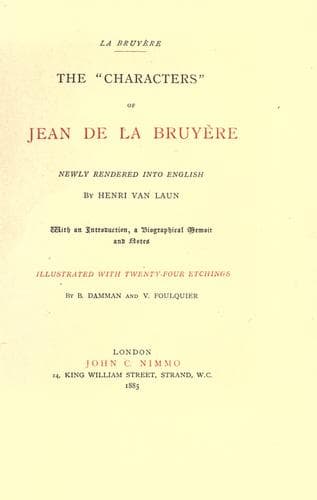
The "Characters" of Jean de La BruyèreLa Bruyère, Jean de
General
The "Characters" of Jean de La Bruyère
La Bruyère, Jean de
Character sketches -- Early works to 1800; Characters and characteristics
call it, a large stage for the display of all her qualities.[630]
(29.) The more natural a handsome woman is, the more amiable she
appears; she loses nothing by being not in full dress, and without any
other ornaments than her beauty and her youth. An artless charm beams
on her countenance and animates every little action, so that there
would be less danger in seeing her adorned in splendid and fashionable
apparel. Thus an honest man is respected for his own sake, independent
of any outward deportment by which he endeavours to give himself a
graver appearance and to make his virtue more apparent. An austere
look, an exaggerated modesty, eccentricity in dress, and a large
skull-cap, add nothing to his probity nor heighten his merit;[631] they
conceal it, and perhaps make it appear less pure and ingenuous than it
is.
Gravity too affected becomes comical; it is like extremities which join
one another, and of which the centre is dignity; this cannot be called
being grave, but acting the part of a grave man; a person who studies
to assume a serious appearance will never succeed. Either gravity is
natural, or there is no such thing, and it is easier to descend from it
than to attain it.
(30.) A man of talent and of good repute, if he is peevish and austere,
frightens young people and gives them a bad opinion of virtue, as they
are afraid it requires too much austerity, and is too tiresome. If,
on the contrary, he is cheerful and easily accessible, his example
is instructive to them, for it teaches them that men may live happy,
do a good deal of work, and yet be serious without giving up decent
diversions; he thus is an exemplar they can follow.
(31.) We should not judge of men by their countenance; but it may serve
to make a guess at their character.
(32.) A clever look in men is the same as regularity of features among
women; it is a kind of beauty which the vainest endeavour to acquire.
(33.) When a man is known to have merit and intelligence, he is
never ugly, however plain he may be; or if even he is ugly, it leaves
no bad impression.[632]
(34.) A good deal of art is needed to return to nature; a good deal of
time, practice, attention, and labour to dance with the same freedom
and ease we walk with; to sing as we speak; to throw as much vivacity,
passion, and persuasion in a studied speech to be publicly delivered as
in one which we sometimes naturally use, without any preparation, and
in familiar conversation.
(35.) They who without sufficient knowledge have a bad opinion of us,
do not wrong us; they do not attack us, but a phantom of their own
imagination.
Public-domain text, read in full here on John Shaqi.
Reviews
Reviews
No reviews yet
Be the first to share your thoughts on this work.
Elsewhere in the archive
Join the Discussion
Join the discussion
Sign in to leave a comment or review.
Sign InorCreate an account