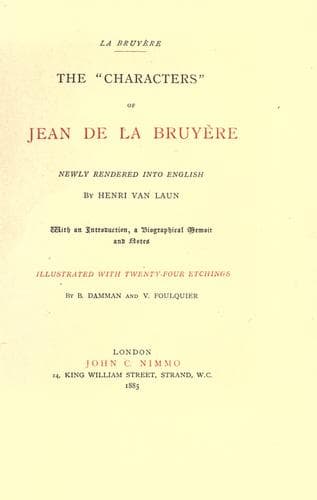
The "Characters" of Jean de La BruyèreLa Bruyère, Jean de
General
The "Characters" of Jean de La Bruyère
La Bruyère, Jean de
Character sketches -- Early works to 1800; Characters and characteristics
(36.) Some trifling regulations have to be followed in certain places,
some duties have to be fulfilled at certain times, and some decorum has
to be observed by certain persons, which could not be divined by the
most intelligent people, and which custom teaches without any trouble:
we should, therefore, not condemn men who omit these things, as they
have not been taught them, neither should we decide their characters by
the shape of their nails or the curl of their hair; if we do form such
a judgment we shall soon find out our error.
(37.) I doubt whether it be lawful to judge of some men by a single
fault, or if extreme necessity, a violent passion, or a sudden impulse
prove anything.
(38.) If we wish to know the truth about certain affairs or certain
persons, we should believe the very opposite of the reports circulated
about them.
(39.) Unless we are very firm and pay continual attention to what we
utter, we are liable to say “yes” and “no” about the same thing or
person in an hourʼs time, induced to do this merely by a sociable and
friendly disposition, which naturally leads a person not to contradict
men who hold different opinions.
(40.) A partial man is exposed to frequent mortifications; for it is
as impossible for his favourites always to be happy or wise as for
those who are out of his favour always to be at fault or unfortunate;
and, therefore, he often is put out of countenance either through the
failure of his friends, or some glorious deed done by those whom he
dislikes.
(41.) A man liable to be prejudiced who ventures to accept an
ecclesiastical or civil dignity is like a blind man wishing to be an
artist, a dumb man who would be an orator, or a deaf man desiring
to judge a symphony; these are but faint comparisons imperfectly
expressing the wretchedness of prejudice. Besides, prejudice is a
desperate and incurable disease, contaminating all who approach the
patient, so that his equals, inferiors, relatives, friends, and even
the doctors abandon him; it is past their skill to work any cure if
they cannot make him confess what is his disease, and acknowledge that
the remedies to heal it are to listen, to doubt, to inquire, and to
examine. Flatterers, rogues, and slanderers, those who never open their
mouths but to lie or to advance their own interests, are the quacks in
whom he trusts, and who make him swallow all they please; they thus
poison and kill him.
(42.) Descartesʼ rule never to decide on the slightest truth before it
is clearly and distinctly understood is sufficiently grand and correct
to extend to the judgment we form of persons.
(43.) Some men have a bad opinion of our intellect, morals, and
manners; but we are well revenged when we see the worthless and base
character of their favourites.
On this principle a man of merit is neglected and a blockhead admired.
(44.) A blockhead is a man without enough intelligence to be a coxcomb.
(45.) A blockhead thinks a coxcomb a man of merit.
Public-domain text, read in full here on John Shaqi.
Reviews
Reviews
No reviews yet
Be the first to share your thoughts on this work.
Elsewhere in the archive
Join the Discussion
Join the discussion
Sign in to leave a comment or review.
Sign InorCreate an account