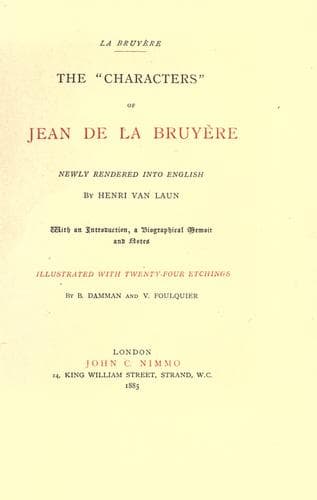
The "Characters" of Jean de La BruyèreLa Bruyère, Jean de
General
The "Characters" of Jean de La Bruyère
La Bruyère, Jean de
Character sketches -- Early works to 1800; Characters and characteristics
(46.) An impertinent man is an egregious coxcomb; a coxcomb wearies,
bores, disgusts, and repels you; an impertinent man repels, embitters,
irritates, and offends; he begins where the other ends.
A coxcomb is somewhat of an impertinent man and of a blockhead, and is
a medley of both.
(47.) Vices arise from a depraved heart; faults from some defect in our
constitution; ridicule from want of sense.
A ridiculous man is one who, whilst he is so, has the appearance of a
blockhead.
A blockhead is always ridiculous, for that is his character; an
intelligent man may sometimes be ridiculous, but will not be so long.
An error in conduct makes a wise man ridiculous.
Foolishness is a criterion of a blockhead, vanity of a coxcomb, and
impertinence of an impertinent man; ridicule seems sometimes to dwell
in those who are really ridiculous, and sometimes in the imagination of
those who believe they perceive ridicule where it neither is nor can be.
(48.) Coarseness, clownishness, and brutality may be the vices of an
intelligent man.
(49.) A stupid man is a silent blockhead, and is more bearable than a
talkative blockhead.
(50.) What is often a slip of the tongue or a jest from a man of sense
is a blunder when said by a blockhead.
(51.) If a coxcomb would be afraid of saying something not exactly
right he would no longer be a coxcomb.
(52.) One proof of a commonplace intellect is to be always relating
stories.
(53.) A blockhead does not know what to do with himself; a coxcomb is
free, easy, and confident in his manners; an impertinent man becomes
impudent; and merit is always modest.
(54.) A conceited man is one in whom a knowledge of certain details,
dignified by the name of business, is added to a very middling
intellect.
One grain of sense and one ounce[633] of business more than there are
in a conceited man, make the man of importance.
While people only laugh at a man of importance he has no other name;
but when they begin to complain of him he may be called arrogant.
(55.) A gentleman is between a clever man and an honest man, though not
as distant from the one as from the other.[634]
The difference between a gentleman and a clever man diminishes each
day, and will soon disappear altogether.
A clever man does not blaze forth his passions, understands his own
interests, sacrifices many things to them, has acquired some wealth,
and knows how to keep it.
A gentleman is not a highwayman, commits no murders, and, in one word,
has no flagrant vices.
It is very well known that an honest man is a gentleman; but it is
comical to think that every gentleman is not an honest man.
An honest man is neither a saint nor a pretender in religion, but has
only confined himself to being virtuous.
(56.) Genius, taste, intelligence, good sense, are all different, but
not incompatible.
Between good sense and good taste there is as much difference as
between cause and effect.
Intelligence is to genius as the whole is in proportion to its part.
Public-domain text, read in full here on John Shaqi.
Reviews
Reviews
No reviews yet
Be the first to share your thoughts on this work.
Elsewhere in the archive
Join the Discussion
Join the discussion
Sign in to leave a comment or review.
Sign InorCreate an account