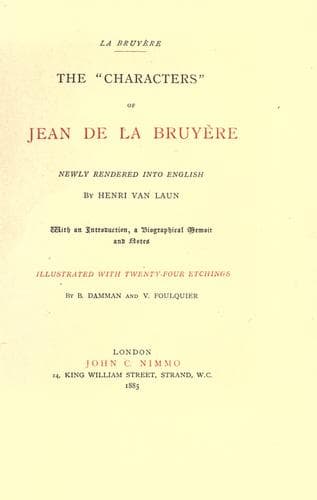
The "Characters" of Jean de La BruyèreLa Bruyère, Jean de
General
The "Characters" of Jean de La Bruyère
La Bruyère, Jean de
Character sketches -- Early works to 1800; Characters and characteristics
(57.) Shall I call a man sensible who only practises one art, or even
a certain science, in which I allow him to be perfect, but beyond that
displays neither judgment, memory, animation, morals, nor manners; does
not understand me; thinks not, and expresses himself badly; a musician,
for example, who, after he has enraptured me with his harmony, seems
to be shut up with his lute in the same case, and when he is without
his instrument is like a machine taken to pieces, in which there is
something wanting and from which nothing more is to be expected?
Again, what shall I say of a certain talent for playing various games,
and who can define it to me? Is there no need of foresight, shrewdness,
or skill in playing ombre[635] or chess? And if there is, how does it
happen that we see men of hardly any intellect excel in these games,
and others of great talent scarcely show moderate ability, and get
confused and bewildered when they have to move a pawn or play a card?
There is something in this world, which, if possible, is still more
difficult to understand. Some person seems dull, heavy, and stupefied;
he knows neither how to speak, nor to relate what he has just seen;
but, if he puts pen to paper, he can tell a tale better than any man;
he makes animals, stones, and trees talk, and everything which does not
speak; his works are light, elegant, natural, and full of delicacy.[636]
Another is simple, timorous, and tiresome in conversation; he mistakes
one word for another, and judges of the excellence of his work
merely by the money it brings him; he cannot read this work aloud,
nor decipher his own handwriting. But let him compose, and he is not
inferior to Augustus, Pompey, Nicomedes, and Heraclius; he is a king,
and a great king, a politician and a philosopher; he undertakes to make
heroes speak and act; he depicts the Romans, and in his verse they are
greater, and more like Romans, than in their own history.[637]
Public-domain text, read in full here on John Shaqi.
Reviews
Reviews
No reviews yet
Be the first to share your thoughts on this work.
Elsewhere in the archive
Join the Discussion
Join the discussion
Sign in to leave a comment or review.
Sign InorCreate an account