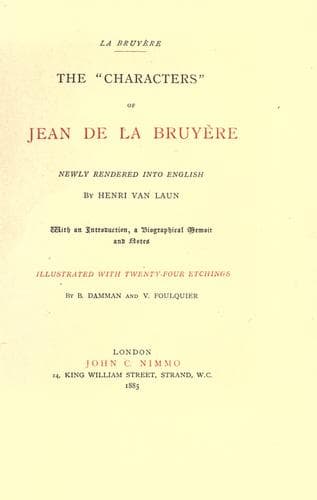
The "Characters" of Jean de La BruyèreLa Bruyère, Jean de
General
The "Characters" of Jean de La Bruyère
La Bruyère, Jean de
Character sketches -- Early works to 1800; Characters and characteristics
(60.) We often pretend to praise immoderately some men who hardly
deserve it, and to raise them, if it were possible, on a level with
those who are really eminent, either because we are tired of admiring
always the same persons, or because their fame, being divided, is less
offensive to behold, and seems to us less brilliant and easier to be
borne.
(61.) We see some men carried along by the propitious gale of favour,
and, in one moment, they lose sight of land, and continue their course;
everything smiles on them, and they are successful in whatever they
undertake; their deeds and their works are extolled and well rewarded,
and when they appear they are caressed and congratulated. A firm rock
stands on the coast, and breakers dash against its base; all the blasts
of power, riches, violence, flattery, authority, and favour cannot
shake it. The public is the rock against which these men are dashed to
pieces.
(62.) It is usual, and, as it were, natural to judge of other menʼs
labour only by the affinity it bears to our own. Thus a poet, filled
with grand and sublime ideas, does not greatly prize an oratorʼs
speech, which is often merely about simple facts; and a man who writes
the history of his native land cannot understand how any person of
sense can spend his whole life in contriving fictions or hunting
after a rhyme; and a divine, immersed in the study of the first four
centuries,[640] thinks all other learning and science sad, idle, and
useless, whilst he perhaps is as much despised by a mathematician.
(63.) A man may have intelligence enough to excel in a particular thing
and lecture on it, and yet not have sense enough to know he ought to be
silent on some other subject of which he has but a slight knowledge; if
such an illustrious man ventures beyond the bounds of his capacity, he
loses his way, and talks like a fool.
(64.) Whether Herillus talks, declaims, or writes, he is continually
quoting; he brings in the prince of philosophers[641] to tell you that
wine will make you intoxicated, and the Roman orator[642] to say that
water qualifies it. When he discourses of morals, it is not he, but the
divine Plato who assures us that virtue is amiable, vice odious, and
that both will become habitual. The most common and well-known things,
which he himself might have thought out, he attributes to the ancients,
the Romans and Greeks; it is not to give more authority to what he
says, nor perhaps to get more credit for learning, but merely for the
sake of employing quotations.
Public-domain text, read in full here on John Shaqi.
Reviews
Reviews
No reviews yet
Be the first to share your thoughts on this work.
Elsewhere in the archive
Join the Discussion
Join the discussion
Sign in to leave a comment or review.
Sign InorCreate an account